Thursday, October 6, 2011
La ética personal / profesional / política: los peligros del trabajo de campo y amistad en la era digital
¿Está buscando consejos sobre cómo cabrear a la gente, perder amigos y deshacer la buena voluntad que han pasado meses construyendo? Si es así, has venido al lugar correcto. En realidad, es mucho más fácil de lo que piensa, y es probable que ya lo ha hecho. Pero por si acaso, te voy a dar algunos consejos rápidos. Acaba de hacer una reunión íntima agradable con los amigos, tomar algunas fotos para que usted y todos tienen recuerdos agradables de la noche, y luego llegar a ser tan superar con buena sensación el deseo de compartir esa buena sensación con sus 543 amigos más íntimos - usted sabe, los que aparecerá en el listado de "amigos" en Facebook - que decide publicar unas fotos (aún sin etiquetas) en Facebook.
Y entonces usted puede volver, atender a sus actividades normales, y esperar a la mierda a golpear el ventilador. Te lo prometo, no tomará mucho tiempo. Al menos no aquí en Guatemala, donde hay una gran cantidad de cautela sobre las redes sociales, sobretodo Facebook. En las últimas dos semanas, ha habido varias desapariciones y al menos un asesinato de los jóvenes (adolescentes y adultos jóvenes) que al parecer acordaron reunirse de personas a las que nunca habían conocido, excepto en Facebook.
Por lo tanto, esto es precisamente lo que hice la semana pasada. No pensar con claridad. No estoy seguro de por qué hice tal error monumental - la colocación de fotografías sin pedir permiso a todas las personas en primer lugar. Muchos de mis amigos aquí en Guatemala también son amigos de FB, y con algunos de ellos, casi la expectativa de que si no hacemos algo juntos y tomar fotos, todos vamos a publicar nuestras fotos en Facebook y la etiqueta de uno al otro. "Esto va en Facebook" , es una frase muy frecuente en nuestras reuniones. Muchos de nosotros en el movimiento de radios comunitarias usan Facebook para comunicarse cuando estamos en nuestros puestos respectivos, enviamos saludos a ser leído por el aire; yo uso el chat de Facebook para tratar de conversaciones y reuniones del plan.
La mayoría de las personas presentes en el evento en cuestión eran amigos de Facebook conmigo y con los demás. Yo con bastante regularidad, publico fotos de los eventos públicos, y, a veces etiqueto a uno o más de ellos (etiquetar a alguien que no aparece realmente en una foto en particular es una muy buena manera de asegurarse de que él o ella toma una mirada a la foto). Supongo que me he acostumbrado tanto al hecho de que la mayoría de mis amigos guatemaltecos quieren que sus fotos son publicadas en Facebook y quieren ser etiquetados que dejé que mi ética profesional y personal quedará sin efecto. Hice una suposición incorrecta de que todos querían compartir todo. Y no pedí permiso antes de publicar fotografías en lo cuales era posible identificar las caras de los individuos (no hay etiquetas, pero algunas de las fotografías de cerca).
No sólo ha habido desapariciones vinculadas a Facebook (yo agrego que no creo que "Facebook" o "redes sociales" es el único culpable, la gente joven en cuestión cada acordaron ir a un lugar relativamente lejano y conocer a una completa extraño - no es una buena idea, independientemente de si el extraño es alguien a quien has encontrado contestando a un pasado de moda "personales" anuncio en un periódico, o alguien a quien encontró en una red social como Twitter o Facebook), pero no ha habido política la violencia relacionada con las personas que divulguen información (o cree que la información divulgada) sobre las operaciones de narcotráfico en las redes sociales. Soy consciente de ello, e incluso intercambiaron algunos comentarios (a través de Facebook, por supuesto) sobre el tema con un colega en México.
Y así he recibido algunos mensajes instantáneos brusca, tras lo cual inmediatamente bajé todas las imágenes en cuestión, y luego algunos correos electrónicos de seguimiento. Por lo tanto, sin siquiera intentarlo, yo había logrado malestar profundamente algunas de las personas quienes me importan mucho, las personas que son amigos y compañeros de lucha. Pedí las disculpas a todos los presentes, y me sentí muy triste y avergonzado. No sé lo que puedo hacer para reparar el daño, sino para ser más vigilante en el futuro.


Personal/professional/political ethics: the perils of fieldwork and friendshipin the digital age
Are you looking for tips on how to piss people off, lose friends and undo goodwill that you have spent months building up? If so, you have come to the right place. It is actually much easier than you think, and you have probably already done it. But just in case, I'll give you some quick pointers. Just make a nice intimate gathering with friends, snap some photos so that you and everyone have nice souvenirs of the evening, and then become so overcome with good feeling the desire to share that good feeling with your 543 most intimate friends --you know, the ones who pop up on your "friends" list on Facebook -- that you decide to post a few photos (even without tags) on Facebook.
And then you can just back, go about your business, and wait for the shit to hit the fan. I promise you, it won't take long. At least not here in Guatemala, where there is a lot of wariness about social networks and especially Facebook. In the last two weeks, there have been several disappearances and at least one murder of young people (teenagers and young adults) who apparently agreed to meet people whom they had never met except on Facebook.
So, this is precisely what I did last weekend. Not thinking very clearly. I'm not sure why I made such an egregious error -- to post photos without asking everyone's permission first. Many of my friends here in Guatemala are also FB friends, and with some of them, there is almost an expectation that if we do something together and take photos, we will all post our photos on Facebook and tag each other. "Esto va para Facebook" (this goes on Facebook) is a pretty frequent refrain in our gatherings. Many of us in the community radio movement use Facebook to communicate when we are at our respective stations; we send greetings to be read over the air; I use Facebook chat to try and plan conversations and meetings.
Most of the people present at the event in question were Facebook friends with me and with each other. I fairly regularly post photos of public events, and sometimes tag one or more of them (tagging someone who does not actually appear in a particular photo is a pretty good way to make sure that he or she takes a look at the photo). I guess I've become so accustomed to the fact that the majority of my Guatemalan friends want to have their photos posted on Facebook and want to be tagged that I allowed my professional and personal ethics to lapse. I made an incorrect assumption that everyone wanted to share everything. And I didn't ask permission before posting identifiable photographs of individuals (there were no tags, but some close up photographs).
Not only have there been disappearances linked to Facebook (I will add that I do not think "Facebook" or "social networks" are solely at fault; the young people in question each agreed to go off to a relatively distant location and meet a complete stranger -- not a good idea regardless of whether the stranger is someone whom you found by answering an old fashioned "personals" ad in a newspaper, or someone whom you encountered on a social network like Twitter or Facebook), but there has been political violence linked to people divulging information (or believed to have divulged information) about narcotrafficking operations on social networks. I am aware of this, and even exchanged some comments (via Facebook, of course) on the subject with a colleague in Mexico.
And so I received some curt IMs, after which I immediately took down all the images in question, and then some follow up emails. So, without even trying, I had managed to deeply upset some of the people about whom I care very deeply, people who are both friends and comrades in struggle. I made an apology to everyone present, and felt very sad and ashamed. I don't know what I can do to repair the damage, except to be more vigilant in the future.
And then you can just back, go about your business, and wait for the shit to hit the fan. I promise you, it won't take long. At least not here in Guatemala, where there is a lot of wariness about social networks and especially Facebook. In the last two weeks, there have been several disappearances and at least one murder of young people (teenagers and young adults) who apparently agreed to meet people whom they had never met except on Facebook.
So, this is precisely what I did last weekend. Not thinking very clearly. I'm not sure why I made such an egregious error -- to post photos without asking everyone's permission first. Many of my friends here in Guatemala are also FB friends, and with some of them, there is almost an expectation that if we do something together and take photos, we will all post our photos on Facebook and tag each other. "Esto va para Facebook" (this goes on Facebook) is a pretty frequent refrain in our gatherings. Many of us in the community radio movement use Facebook to communicate when we are at our respective stations; we send greetings to be read over the air; I use Facebook chat to try and plan conversations and meetings.
Most of the people present at the event in question were Facebook friends with me and with each other. I fairly regularly post photos of public events, and sometimes tag one or more of them (tagging someone who does not actually appear in a particular photo is a pretty good way to make sure that he or she takes a look at the photo). I guess I've become so accustomed to the fact that the majority of my Guatemalan friends want to have their photos posted on Facebook and want to be tagged that I allowed my professional and personal ethics to lapse. I made an incorrect assumption that everyone wanted to share everything. And I didn't ask permission before posting identifiable photographs of individuals (there were no tags, but some close up photographs).
Not only have there been disappearances linked to Facebook (I will add that I do not think "Facebook" or "social networks" are solely at fault; the young people in question each agreed to go off to a relatively distant location and meet a complete stranger -- not a good idea regardless of whether the stranger is someone whom you found by answering an old fashioned "personals" ad in a newspaper, or someone whom you encountered on a social network like Twitter or Facebook), but there has been political violence linked to people divulging information (or believed to have divulged information) about narcotrafficking operations on social networks. I am aware of this, and even exchanged some comments (via Facebook, of course) on the subject with a colleague in Mexico.
And so I received some curt IMs, after which I immediately took down all the images in question, and then some follow up emails. So, without even trying, I had managed to deeply upset some of the people about whom I care very deeply, people who are both friends and comrades in struggle. I made an apology to everyone present, and felt very sad and ashamed. I don't know what I can do to repair the damage, except to be more vigilant in the future.
L'shana tova in the altiplano -- the first meal


Procuring yeast proved to be a little more complicated as I discovered that yeast is not generally available in stores. I tried my favorite all-purpose store in Antigua, La Bodegona, which carries a fair amount of specialty items like Celestial Seasonings tea and Chinese or Thai rice stick noodles and roasted macademia nuts. They didn't have any yeast. I asked Jeanet, my colleague at the radio station, where people in Quiché buy yeast, since everyone makes bread for Semana Santa (Holy Week). She told me to go to a bakery. There are a lot of bakeries in Santa Cruz but stopping at one means finding a parking space. So on Monday evening I went to one of the bakeries in Chinique and asked if they sold yeast -- it's a bakery on the main street a couple of doors down from my landlord, Modesto's, store. The young woman said yes, they did, but they had none left. I asked if they would have some the next day and she said yes, but not until the afternoon, so I asked her to make sure she set some aside for me so that I wouldn't have the same experience, that it was all gone, and said I wouldn't be able to be there until about 7 p.m.

Purchasing wine also required advance planning as there are only a few places to buy wine in my part of El Quiché -- a store in Chiché that carries one not-very-stellar variety of Chilean wine, a few places in Santa Cruz and in Chichicastenango. The variety is better and so are the prices in Antigua, but I hardly go there anymore, so I had to think about this part of the festivity about a week and a half in advance.
And then there was the subject of plates and utensils, Most Guatemalan households have a lot more people than mine; many extended families live either in the same dwelling or separate structures on the property (as Doña Mati's family). Sometimes most of the extended family cooks and eats together. In any case, most Guatemalan households, at least the ones I have visited here in the altiplano, have a lot of plates and utensils. I have gradually expanded my supply but since I only occasionally have people over and I am leaving in a few months I haven't wanted to accumulate THAT much in the way of household goods (I am already dreading the process of distributing all of this before I leave, but that' another story; I will start crying for sure if I start down that path now).


So I had pretty much everything I needed by the night before and started some of the preparations, but mostly they needed to be done the day of. And so I left early, got home and started on bread dough and the chicken and the vegetables salads. My friend Caterino had offered to have his wife Sandra come and help with preparations, but she didn't actually arrive until after 5. I had tried unsuccessfully to get the wood-burning stove going, thinking I'd cook the chicken on that. Sometimes I can get the stove going with no trouble, other times, nothing I seem to do works. Sandra had brought a spare pot (since I realized that I wouldn't be able to make enough rice in my rice cooker, and didn't have another pot that would be large enough, as my one good-sized pot was devoted to the chicken), some masa to make tortillas, and some lime to clean off the stove top (I discovered

Making the challah dough was not quite as straightforward as it usually is. We are at a much higher altitude here than in New York -- about 5000 feet above sea level. I've been making challah every since since 1974, my sophomore year in college, but mostly at or around sea level. Everything here is different, not just the altitude. The yeast is different; the flour is different (wheat grows differently depending upon the soil and climate, and has a different gluten content); the water is different; the air is different (there is natural yeast in the air as well as other microbes that affect locale- and environment-sensitive foods like bread, cheese, wine). Everything, really (maybe the eggs, oil, salt and honey have a more or less similar chemistry to those in the U.S.). So, I had bought two pounds of flour, with an eye toward making challah and honey cake. I assumed, based on previous experience, that this quantity should be sufficient for both. Was I wrong. I used a little bit less water than I normally do, but as I kneaded I kept on adding flour but the dough never really got un-sticky and so I eventually left it. No honey cake this time. There simply wasn't enough flour.

The challah dough rose slowly, but it seemed to be okay. Until I turned it out and tried to shape it into three long strips so that I could braid it as I usually do. Challah for the new year is usually made in a round shape (as opposed to the rest of the year: challah is traditionally prepared on the sabbath, but in a regular oblong loaf), to symbolize the continuum, the cyclical nature of life. Or at least that's how it has been explained to me. I usually make a braid and then shape the braid into a round, or if I am especially ambitious I make two braids, one larger and one smaller, and place the smaller braid on top of the larger one and make that into a round. But when I tried to cut the dough into strips it was too sticky to easily handle and so I gave up and just decided to make a round. Luckily I had purchased a round cake pan and so that helped keep the shape.


Wednesday, October 5, 2011
All eyes on Wall Street
For the last several days much of my attention has been focused on the Occupy Wall Street (OWS) movement, back in my home town of New York. So I haven't been as attentive to keeping up with the blog. For the first time since I've been here, I've had a strong urge to go back, just for a moment, to witness for myself and participate if only for a moment. Perhaps the occupation or some offshoot will still be happening when I return in January, but in any case I'd like to have some firsthand experience of it...
Mental health break (sort of): Escape from Chinique
It's not just that life in a very small town gets kind of boring. Especially if one is accustomed to the manifold diversions of New York. And I live a pretty modest life in New York -- I'm not out gallivanting around to A-list restaurants and nightclubs serving $15 watermelon martinis (or whatever is in vogue this week). But I like to go to the movies -- I prefer to see films on a big screen and in the company of other people, rather than just watch them on DVDs at home. I try to support independent cinemas like the Film Forum, IFC, and Anthology Film Archives. Here, the diversions are very limited. My town has nothing. Evangelical churches, a few very modest restaurants, and a few weeks ago the father of my landlord opened a small cantina a few doors down the street from the corner store the family runs.
I don't have a television. However, through the generosity of some friends I've acquired media files of some films and two seasons of Treme, so I have judiciously doled out the limited entertainment. I also have a number of 19th and early 20th century novels I acquired for my e-book reader -- these are all public domain works since they are over 75 years old and the copyrights have expired. Luckily I like a lot of the fiction of this period (the longer the novel, the more complex the plot line, the more detailed the descriptions, the happier I get.. sometimes) so I have been happily catching up on my Trollope and Thackeray and George Eliot.
However, even Victorian fiction has its limitations. So, I decided that I needed to go to a movie. I made this decision back in August when the Harry Potter film came out here. However, not only is there nothing much to do in my town, there is not a single movie theater in the entire department of El Quiché. There apparently was one in Santa Cruz some years back but it was closed because, as I was told, guerrilla sympathizers used to meet there. There are movie theaters (chain multiplexes) in Guatemala City (I pass one along the highway), Chimaltenango (one of my least favorite places, although I have to say I am only judging by the part you can see from the highway) and a few other places. I hadn't realized there was a movie theater in Xela until my friend P.M., who lives in San Marcos, told me that he had gone to see Harry Potter in Xela. So I thought, why not go to a movie in Xela some weekend? Folks seemed interested in Harry Potter, and I figured if we went early on a Saturday we could go to an early movie and then return to Quiché (I knew i would be able to find a friend to put me up, but I worried abut my friends since they would have had to pay for lodgings).
Then the elections hit and I was tied up and couldn't see my clear to finding a Sunday where we could do this (several of my friends are completing their college education by taking classes on Saturdays, which means they are tied up all day every Saturday) until after the elections. By which time Harry Potter was long gone from local theaters. Damn!
So finally I decided that I was just going to go myself and try to meet up with P.M. (San Marcos, where he lives, is a 40-minute bus ride from Xela, so he goes to Xela pretty regularly). Another friend, S.J., who works with Cultural Survival, was spending a few weeks in Xela, so I contacted him as well, and then my friend H.R., who lives in Xela, and said I'd like to invite him and his wife (whom I had yet to meet). H.R. told me that he hadn't been to the movies in 30 years and had actually never gone to the movies with his wife (they do watch films at home but have never gone to a movie theater together). So then we had to pick a film. The pickings were pretty slim: Noche de los Demonios and Planeta de los Simios Revolución (the English title is Rise of the Planet of the Apes but I prefer the Spanish title) seemed to be the top picks. I did what we do nowadays: posted on Facebook and asked for opinions. The masses (my friends on FB, or at least those who bothered to chime in) decided that we should see Planet of the Apes and so that was our choice (luckily the people who were actually going to attend the film were in agreement).
 Of course, I always try to squeeze in some work, so I contacted one of the leaders in the community radio movement, Tino, with whom I have been trying to have an interview/conversation for a while, but we never seem to manage our schedules. He lives in San Mateo, a small town about 5 km. outside of Xela, and we had planned to meet at 4, so that I could make it to a 7:50 movie. Tino lives right by the community radio station there, Doble Via, which he helped found, and I figured I could also stop in at the station and say hello to friends there. San Mateo is along the highway to San Marcos, so I figured that PM would be coming that way on the bus and if we could time it right he could get off the bus at San Mateo, I could pick him up and he could come to the radio station with me. And Sanjay was going to be at the radio station anyhow, so I told Tino to tell SJ to just wait for me and I'd give him a ride into Xela.
With rapid-fire cell phone calls back and forth PM and I managed to meet up even though he got off at the wrong overpass (there are two pasarelas in San Mateo and the bus driver hadn't understood which one PM needed to get off at), and then headed to Doble Via. Tino didn't respond to my phone calls (he had said he was going to be at a meeting earlier in the day but would be back before 4) and didn't appear to be around. PM and I were sitting in my pick up parked in front of the radio and I was just dialing SJ's number when he appeared up the road, walking in our direction. Tino had not given him the message and he was about to head into Xela but decided to hang with us and catch a ride. Tino eventually showed up but for a host of reasons was not able to do the interview, so we just went up to the radio station and talked with some of the volunteers there. It is a radio station run by young people from the area, ranging in age from 10 to early 20s. Some are students at local universities, but all are from the immediate area. I'd met several of the members of the station when we were at the Encuentro in Guatemala City, and when Jeanet and I briefly came to Xela several weeks ago to pick up some supplies for our radio station, so it was good to reconnect. SJ showed us what he was working on. Tino was involved in one of the clandestine radio stations run by the guerrilla movement during the armed struggle. The radio station had recorded programs on cassette which were then broadcast, and he had kept all the cassettes, which SJ was now digitizing, and he was also trying to arrange for some universities in the states to purchase the archives, which would also provide some much-needed funds.
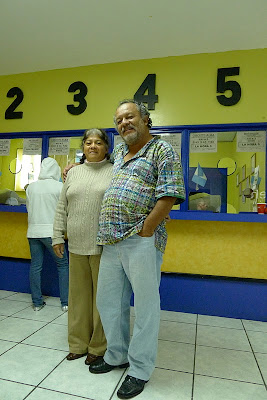
We chatted for a while with the folks working at the station, and watched with interest as a new volunteer was being trained, and then took off to meet Humberto. Humberto had to pick up his wife and so there wasn't going to be time to eat before the movie. I've known Humberto or several months and had met one of his sons, but had never met his wife Ana before. She is a calm, easy-going, and very pleasant woman who is a professor nursing. I got out of the front seat thinking she would want to sit next to her husband, but she happily got in the back with the two young men, laughing "Maybe something will happen." We got to the theater with time to spare -- located inside one of the large centros comerciales (shopping malls). We worked our way past clothing and jewelry stores and found the theater and got our tickets, and I took some photos of Humberto and Ana in front of the box office (since the theater is inside a mall and it was raining heavily, no way to take a photo outside of the marquee; the marquee is somewhere on one of the streets that go past the mall. We then loaded up on popcorn and snacks and went inside to discover we were the only patrons in the theater. We were, however, later joined by about 5-8 other people (they came in when the previews had already started so I couldn't really see how many there were).
The movie was not bad for Hollywood fare. Maybe you've seen it: the basic message is that zoos and animal testing are bad and that creatures will not stand for being endlessly repressed and mistreated. I don't think that's a spoiler. The one disturbing note was that the head of the big pharma company, who is one (but not the only one) of the film's villains, is black. But otherwise, an agreeable change of pace from my little house in the boondocks. We went back to Humberto's home and Ana heated up some tamales made of potatoes and others made of rice -- specialties of Quetzaltenango and quite yummy.

I had brought a bottle of kuxa (pronounced "koosha"), a local moonshine that is widely consumed in the highlands. It turns out that my little town is renowned for its kuxa -- had I known this? No, I did not ... until two day before the election when I was out driving around with Doña Mati and Doña Fermi and talking about the need to celebrate whether or not Mati was elected. Somehow we got on the subject of kuxa, which people had always talked about. I told them that I had been hearing about kuxa for months but had never tasted any, as far as I had known, and didn't know where to get it. "Oh, Chinique is where to get kuxa," they told me. Mati told me that her parents, who live in one of the sixty-three communities that comprise the municipality of Santa Cruz del Quiché, made the trip to Chinique when they needed kuxa. So as our route took us through Chinique, we decided to get some. First we stopped at my house and got some empty bottles (I had several 600 ml bottles from bottled water, and one empty wine bottle with a cork), as this is strictly BYOB. I drove slowly as they tried to remember where they had gotten it before. It turned out the vendor is a block and a half from my house. I stopped and we got out; Fermi knocked on the metal door of the house and a young boy answered. He told us to enter through the garage and so we did. We stood in the kitchen of a large house and a middle aged Ladina woman attended us. We asked for a gallon, hoping that the bottles we had were enough. She found a gallon container and filled it with kuxa, and then found a funnel and filled up our bottles and we set off. I decided to bring a bottle to Humberto since he had always been talking about drinking kuxa, and so while we were waiting for the tamales to heat up, we tried it.
It was strong tasting, very much like aguardiente, not unpleasant at all. But very strong -- not only in taste but in alcohol content. None of us drank more than a small nip, and I am not sure PM and SJ finished theirs. However, when I returned to Xela a week later to celebrate Rosh Hashonah, I didn't see any evidence of the bottle, so I guess it got finished.
 Actually, the best part of the trip was what you can see in the picture. During the last weeks of the campaign, my buddies in the movement were all sporting their very cool Winaq jackets. I asked one of them if it would be possible to get one, and he said, "Of course, we'll get you one," and then that was the last I heard about it from him. I would, of course, have offered to buy one but I knew that they were not for sale; they were given to people who were cadre, candidates, key supporters. I had made a joke of it in my conversations with Doña Mati and Doña Fermi; Mati said Otilia Lux (pronounced Loosh), a member of the national executive committee and a candidate for the Central American Parliament, had given her a vest but she didn't know where she had it. So I dropped a hint or two with other friends, and then also mentioned this to Rigoberta Menchú's brother-in-law, whom I met around election day. I mean, I would have survived the disappointment if I hadn't gotten one, but I really wanted to have one. So when I walked into Humberto's house, he said, "We have your jacket" and brought out one that had to be XXXL. He told me it was the only one that was available, but it's fine. I think I can fit three people into it, but I can probably figure out a way to make it look gangsta cool.
I don't have a television. However, through the generosity of some friends I've acquired media files of some films and two seasons of Treme, so I have judiciously doled out the limited entertainment. I also have a number of 19th and early 20th century novels I acquired for my e-book reader -- these are all public domain works since they are over 75 years old and the copyrights have expired. Luckily I like a lot of the fiction of this period (the longer the novel, the more complex the plot line, the more detailed the descriptions, the happier I get.. sometimes) so I have been happily catching up on my Trollope and Thackeray and George Eliot.
However, even Victorian fiction has its limitations. So, I decided that I needed to go to a movie. I made this decision back in August when the Harry Potter film came out here. However, not only is there nothing much to do in my town, there is not a single movie theater in the entire department of El Quiché. There apparently was one in Santa Cruz some years back but it was closed because, as I was told, guerrilla sympathizers used to meet there. There are movie theaters (chain multiplexes) in Guatemala City (I pass one along the highway), Chimaltenango (one of my least favorite places, although I have to say I am only judging by the part you can see from the highway) and a few other places. I hadn't realized there was a movie theater in Xela until my friend P.M., who lives in San Marcos, told me that he had gone to see Harry Potter in Xela. So I thought, why not go to a movie in Xela some weekend? Folks seemed interested in Harry Potter, and I figured if we went early on a Saturday we could go to an early movie and then return to Quiché (I knew i would be able to find a friend to put me up, but I worried abut my friends since they would have had to pay for lodgings).
Then the elections hit and I was tied up and couldn't see my clear to finding a Sunday where we could do this (several of my friends are completing their college education by taking classes on Saturdays, which means they are tied up all day every Saturday) until after the elections. By which time Harry Potter was long gone from local theaters. Damn!
So finally I decided that I was just going to go myself and try to meet up with P.M. (San Marcos, where he lives, is a 40-minute bus ride from Xela, so he goes to Xela pretty regularly). Another friend, S.J., who works with Cultural Survival, was spending a few weeks in Xela, so I contacted him as well, and then my friend H.R., who lives in Xela, and said I'd like to invite him and his wife (whom I had yet to meet). H.R. told me that he hadn't been to the movies in 30 years and had actually never gone to the movies with his wife (they do watch films at home but have never gone to a movie theater together). So then we had to pick a film. The pickings were pretty slim: Noche de los Demonios and Planeta de los Simios Revolución (the English title is Rise of the Planet of the Apes but I prefer the Spanish title) seemed to be the top picks. I did what we do nowadays: posted on Facebook and asked for opinions. The masses (my friends on FB, or at least those who bothered to chime in) decided that we should see Planet of the Apes and so that was our choice (luckily the people who were actually going to attend the film were in agreement).

With rapid-fire cell phone calls back and forth PM and I managed to meet up even though he got off at the wrong overpass (there are two pasarelas in San Mateo and the bus driver hadn't understood which one PM needed to get off at), and then headed to Doble Via. Tino didn't respond to my phone calls (he had said he was going to be at a meeting earlier in the day but would be back before 4) and didn't appear to be around. PM and I were sitting in my pick up parked in front of the radio and I was just dialing SJ's number when he appeared up the road, walking in our direction. Tino had not given him the message and he was about to head into Xela but decided to hang with us and catch a ride. Tino eventually showed up but for a host of reasons was not able to do the interview, so we just went up to the radio station and talked with some of the volunteers there. It is a radio station run by young people from the area, ranging in age from 10 to early 20s. Some are students at local universities, but all are from the immediate area. I'd met several of the members of the station when we were at the Encuentro in Guatemala City, and when Jeanet and I briefly came to Xela several weeks ago to pick up some supplies for our radio station, so it was good to reconnect. SJ showed us what he was working on. Tino was involved in one of the clandestine radio stations run by the guerrilla movement during the armed struggle. The radio station had recorded programs on cassette which were then broadcast, and he had kept all the cassettes, which SJ was now digitizing, and he was also trying to arrange for some universities in the states to purchase the archives, which would also provide some much-needed funds.
We chatted for a while with the folks working at the station, and watched with interest as a new volunteer was being trained, and then took off to meet Humberto. Humberto had to pick up his wife and so there wasn't going to be time to eat before the movie. I've known Humberto or several months and had met one of his sons, but had never met his wife Ana before. She is a calm, easy-going, and very pleasant woman who is a professor nursing. I got out of the front seat thinking she would want to sit next to her husband, but she happily got in the back with the two young men, laughing "Maybe something will happen." We got to the theater with time to spare -- located inside one of the large centros comerciales (shopping malls). We worked our way past clothing and jewelry stores and found the theater and got our tickets, and I took some photos of Humberto and Ana in front of the box office (since the theater is inside a mall and it was raining heavily, no way to take a photo outside of the marquee; the marquee is somewhere on one of the streets that go past the mall. We then loaded up on popcorn and snacks and went inside to discover we were the only patrons in the theater. We were, however, later joined by about 5-8 other people (they came in when the previews had already started so I couldn't really see how many there were).
The movie was not bad for Hollywood fare. Maybe you've seen it: the basic message is that zoos and animal testing are bad and that creatures will not stand for being endlessly repressed and mistreated. I don't think that's a spoiler. The one disturbing note was that the head of the big pharma company, who is one (but not the only one) of the film's villains, is black. But otherwise, an agreeable change of pace from my little house in the boondocks. We went back to Humberto's home and Ana heated up some tamales made of potatoes and others made of rice -- specialties of Quetzaltenango and quite yummy.

I had brought a bottle of kuxa (pronounced "koosha"), a local moonshine that is widely consumed in the highlands. It turns out that my little town is renowned for its kuxa -- had I known this? No, I did not ... until two day before the election when I was out driving around with Doña Mati and Doña Fermi and talking about the need to celebrate whether or not Mati was elected. Somehow we got on the subject of kuxa, which people had always talked about. I told them that I had been hearing about kuxa for months but had never tasted any, as far as I had known, and didn't know where to get it. "Oh, Chinique is where to get kuxa," they told me. Mati told me that her parents, who live in one of the sixty-three communities that comprise the municipality of Santa Cruz del Quiché, made the trip to Chinique when they needed kuxa. So as our route took us through Chinique, we decided to get some. First we stopped at my house and got some empty bottles (I had several 600 ml bottles from bottled water, and one empty wine bottle with a cork), as this is strictly BYOB. I drove slowly as they tried to remember where they had gotten it before. It turned out the vendor is a block and a half from my house. I stopped and we got out; Fermi knocked on the metal door of the house and a young boy answered. He told us to enter through the garage and so we did. We stood in the kitchen of a large house and a middle aged Ladina woman attended us. We asked for a gallon, hoping that the bottles we had were enough. She found a gallon container and filled it with kuxa, and then found a funnel and filled up our bottles and we set off. I decided to bring a bottle to Humberto since he had always been talking about drinking kuxa, and so while we were waiting for the tamales to heat up, we tried it.
It was strong tasting, very much like aguardiente, not unpleasant at all. But very strong -- not only in taste but in alcohol content. None of us drank more than a small nip, and I am not sure PM and SJ finished theirs. However, when I returned to Xela a week later to celebrate Rosh Hashonah, I didn't see any evidence of the bottle, so I guess it got finished.

Sunday, October 2, 2011
L'shana tova en el altiplano: reflexiones antropológicas
[NOTA: La frase l'shana tova es un saludo en hebreo que se dice mucho en la temporada del año nuevo. Más o menos quiere decir, "Que tenga un año bueno."]
Una de las razones por las que era tan importante para mí compartir este día de fiesta con mis amigos es que los antropólogos tienen una mala reputación (y es bien merecida) de ser esponjas - es decir, ir a lugares y pidiendo a la gente a compartir sus culturas , costumbres, tradiciones, ideas e historias de vida con nosotros, en un intercambio casi completo de un solo lado. Esto también es cierto de algunos turistas culturales, que se desplazan para consumir y participar, y sí aprecia... pero rara vez con el sentido de que debe corresponder al compartir algo de lo que somos, de dónde venimos, y lo que se trata nuestra vida. En parte, esto proviene de la forma en que estamos capacitados para escuchar y observar en lugar de intervenir y de imponer a nosotros mismos y nuestros puntos de vista y valores tan poco como sea posible.
Obviamente, hay muchos que están tratando de cambiar eso, y para ser más recíproca. Después de todo, si estamos pidiendo a la gente a compartir lo que a veces son experiencias, ideas y recuerdos muy privadas y también dolorosas, debemos estar dispuestos a hacer lo mismo ... sin necesidad de encender el intercambio en un ejercicio narcisista que se convierte en algo que trata solamente de nosotros.
Por lo tanto, ya que la gente ha sido muy generosa conmigo - y generosa en todo tipo de formas, no sólo la apertura de sus hogares y compartiendo sus alimentos, pero también me hayan invitado a ser parte de momentos muy particulares, y compartir sus puntos de vista sobre lo que podría ser sujetos no muy populares o polémicos - que quería honrar la generosidad y la reciprocidad de alguna manera. Uno de mis amigos / compañeros argumenta que no hay que pensar en las amistades y las relaciones políticas en términos de las deudas o los intercambios, y me resulta difícil expresar lo que quiero decir sin caer en ese discurso, así que espero que se perdonar a esta excursión. He sido muy privilegiada por la confianza, la verdadera amistad y el compañerismo que se ha ofrecido a mí, y por eso quise tratar de abrir una ventana a mis amigos en algunas partes de lo que soy y lo que valoro.
Además, me puse a pensar sobre algunos de los paralelos (así como las diferencias) entre la "experiencia judía" y la de los pueblos mayas y otros pueblos indígenas. Una de las razones por las que mis padres ateos y comunistas mantuvieron una identificación cultural fuerte como Judios fue a causa de la historia de la discriminación, la represión, y así sucesivamente (no quiero que dejarse llevar aquí, esta línea de pensamiento es de uso frecuente para justificar algunas de las políticas más atroces del estado de Israel, o se convierte en un concurso para ver quién es más oprimido). Además, la coincidencia de la expulsión de los Judios de la Península Ibérica y los viajes de Colón y la conversión forzada, el papel de la Inquisición en el mundo antiguo y el mundo "nuevo", fueron parte de mis reflexiones. Por último, mis amigos en Xela y yo habíamos estado todos muy involucrados (y la mayoría de ellos mucho más que yo) en la campaña electoral de Winaq y el Frente Amplio. Algunas semanas atrás, antes de las elecciones, estábamos diciendo que íbamos a celebrar después de las elecciones, no importa cuál sea el resultado, para honrar el esfuerzo y la intención y el trabajo duro. Y, en el caso de Doña Mati y Doña Fermi, el hecho de que nos las arreglamos para conseguir cualquier tipo de campaña va en absoluto. Así que desde el año nuevo judío llegó unas semanas después de la elección, y para mí el año nuevo siempre ha simbolizado un tiempo de reflexión y de la regeneración, que parecía totalmente adecuado. Y, entonces, los acontecimientos ocurriendo en Nueva York y otros lugares han traído a la mente que la consigna del movimiento por la jornada de 8 horas, que el espíritu humano ha de ser alimentado no sólo de pan sino también con las rosas.
Una de las razones por las que era tan importante para mí compartir este día de fiesta con mis amigos es que los antropólogos tienen una mala reputación (y es bien merecida) de ser esponjas - es decir, ir a lugares y pidiendo a la gente a compartir sus culturas , costumbres, tradiciones, ideas e historias de vida con nosotros, en un intercambio casi completo de un solo lado. Esto también es cierto de algunos turistas culturales, que se desplazan para consumir y participar, y sí aprecia... pero rara vez con el sentido de que debe corresponder al compartir algo de lo que somos, de dónde venimos, y lo que se trata nuestra vida. En parte, esto proviene de la forma en que estamos capacitados para escuchar y observar en lugar de intervenir y de imponer a nosotros mismos y nuestros puntos de vista y valores tan poco como sea posible.
Obviamente, hay muchos que están tratando de cambiar eso, y para ser más recíproca. Después de todo, si estamos pidiendo a la gente a compartir lo que a veces son experiencias, ideas y recuerdos muy privadas y también dolorosas, debemos estar dispuestos a hacer lo mismo ... sin necesidad de encender el intercambio en un ejercicio narcisista que se convierte en algo que trata solamente de nosotros.
Por lo tanto, ya que la gente ha sido muy generosa conmigo - y generosa en todo tipo de formas, no sólo la apertura de sus hogares y compartiendo sus alimentos, pero también me hayan invitado a ser parte de momentos muy particulares, y compartir sus puntos de vista sobre lo que podría ser sujetos no muy populares o polémicos - que quería honrar la generosidad y la reciprocidad de alguna manera. Uno de mis amigos / compañeros argumenta que no hay que pensar en las amistades y las relaciones políticas en términos de las deudas o los intercambios, y me resulta difícil expresar lo que quiero decir sin caer en ese discurso, así que espero que se perdonar a esta excursión. He sido muy privilegiada por la confianza, la verdadera amistad y el compañerismo que se ha ofrecido a mí, y por eso quise tratar de abrir una ventana a mis amigos en algunas partes de lo que soy y lo que valoro.
Además, me puse a pensar sobre algunos de los paralelos (así como las diferencias) entre la "experiencia judía" y la de los pueblos mayas y otros pueblos indígenas. Una de las razones por las que mis padres ateos y comunistas mantuvieron una identificación cultural fuerte como Judios fue a causa de la historia de la discriminación, la represión, y así sucesivamente (no quiero que dejarse llevar aquí, esta línea de pensamiento es de uso frecuente para justificar algunas de las políticas más atroces del estado de Israel, o se convierte en un concurso para ver quién es más oprimido). Además, la coincidencia de la expulsión de los Judios de la Península Ibérica y los viajes de Colón y la conversión forzada, el papel de la Inquisición en el mundo antiguo y el mundo "nuevo", fueron parte de mis reflexiones. Por último, mis amigos en Xela y yo habíamos estado todos muy involucrados (y la mayoría de ellos mucho más que yo) en la campaña electoral de Winaq y el Frente Amplio. Algunas semanas atrás, antes de las elecciones, estábamos diciendo que íbamos a celebrar después de las elecciones, no importa cuál sea el resultado, para honrar el esfuerzo y la intención y el trabajo duro. Y, en el caso de Doña Mati y Doña Fermi, el hecho de que nos las arreglamos para conseguir cualquier tipo de campaña va en absoluto. Así que desde el año nuevo judío llegó unas semanas después de la elección, y para mí el año nuevo siempre ha simbolizado un tiempo de reflexión y de la regeneración, que parecía totalmente adecuado. Y, entonces, los acontecimientos ocurriendo en Nueva York y otros lugares han traído a la mente que la consigna del movimiento por la jornada de 8 horas, que el espíritu humano ha de ser alimentado no sólo de pan sino también con las rosas.
L'shana tova in the altiplano: anthropological reflection
One of the reasons it was so important to me to share this holiday with my friends here is that anthropologists have an unfortunate reputation (and it is well-deserved) for being sponges -- that is, going places and asking people to share their cultures, customs, traditions, ideas, and life stories with us, in a nearly entirely one-sided exchange. This is also true of some cultural tourists, who travel to consume and participate, and yes, appreciate.. but rarely with the sense that we should reciprocate by sharing something of who we are, where we come from, and what we are all about. In part this comes from how we are trained to listen and observe rather than intervene, and to impose ourselves and our views and values as little as possible.
There are obviously many who are trying to shift that, and to be more reciprocal. After all, if we are asking people to share what are sometimes private and also painful experiences, ideas and memories, we should be ready to do the same... without turning the exchange into a narcissistic exercise where it becomes all about us.
So, since people have been so generous with me -- and generous in all kinds of ways, not just opening their homes and sharing their food but also inviting me to be part of some very private moments, and also sharing their views on what might be unpopular or controversial subjects -- I wanted to honor that generosity and reciprocate in some small way. One of my friends/comrades argues that we shouldn't think about friendships and political relationships in terms of debts or exchanges, and I'm finding it hard to express what I want to say without falling into that discourse, so I hope he will forgive this excursion. I have been very privileged by the trust, true friendship and comradeship that has been offered to me, and so I wanted to try and open a window for my friends into some parts of who I am and what I value.
Also, I started to think about some of the parallels (as well as the differences) between the "Jewish experience" and that of the Maya and other indigenous peoples. One of the reasons that my atheist communist parents maintained a strong cultural identification as Jews was to because of the history of discrimination, repression, and so forth (I don't want to get too carried away here; this line of thinking is often used to justify some of the more egregious policies of the state of Israel, or it turns into a contest to see who is more oppressed). Also, the coincidence of the expulsion of the Jews from the Iberian peninsula and Columbus' voyages and the forced conversions, the role of the inquisition in the old and "new" worlds, were part of my reflections. Finally, my friends in Xela and I had all been deeply involved (and most of them much more than I) in the electoral campaign for Winaq and the Frente Amplio. Some weeks back, before the election, we had been saying that we were going to celebrate after the election no matter what the outcome, to honor the effort and the intention and the hard work. And, in the case of Doña Mati and Doña Fermi, the fact that we managed to get any kind of campaign going at all. So since the Jewish new year came a few weeks after election, and for me the new year has always symbolized a time of reflection and regeneration, it seemed completely appropriate. And, then, unfolding events in New York and elsewhere have brought to mind that slogan from the movement for the 8 hour day, that the human spirit has to be nourished not just with bread but also with roses.
There are obviously many who are trying to shift that, and to be more reciprocal. After all, if we are asking people to share what are sometimes private and also painful experiences, ideas and memories, we should be ready to do the same... without turning the exchange into a narcissistic exercise where it becomes all about us.
So, since people have been so generous with me -- and generous in all kinds of ways, not just opening their homes and sharing their food but also inviting me to be part of some very private moments, and also sharing their views on what might be unpopular or controversial subjects -- I wanted to honor that generosity and reciprocate in some small way. One of my friends/comrades argues that we shouldn't think about friendships and political relationships in terms of debts or exchanges, and I'm finding it hard to express what I want to say without falling into that discourse, so I hope he will forgive this excursion. I have been very privileged by the trust, true friendship and comradeship that has been offered to me, and so I wanted to try and open a window for my friends into some parts of who I am and what I value.
Also, I started to think about some of the parallels (as well as the differences) between the "Jewish experience" and that of the Maya and other indigenous peoples. One of the reasons that my atheist communist parents maintained a strong cultural identification as Jews was to because of the history of discrimination, repression, and so forth (I don't want to get too carried away here; this line of thinking is often used to justify some of the more egregious policies of the state of Israel, or it turns into a contest to see who is more oppressed). Also, the coincidence of the expulsion of the Jews from the Iberian peninsula and Columbus' voyages and the forced conversions, the role of the inquisition in the old and "new" worlds, were part of my reflections. Finally, my friends in Xela and I had all been deeply involved (and most of them much more than I) in the electoral campaign for Winaq and the Frente Amplio. Some weeks back, before the election, we had been saying that we were going to celebrate after the election no matter what the outcome, to honor the effort and the intention and the hard work. And, in the case of Doña Mati and Doña Fermi, the fact that we managed to get any kind of campaign going at all. So since the Jewish new year came a few weeks after election, and for me the new year has always symbolized a time of reflection and regeneration, it seemed completely appropriate. And, then, unfolding events in New York and elsewhere have brought to mind that slogan from the movement for the 8 hour day, that the human spirit has to be nourished not just with bread but also with roses.
Subscribe to:
Posts (Atom)