As part of this sprawling project, I visited a few additional sites in the capital, ones that I either hadn't known about previously or ones that for one reason or another I hadn't visited, and revisited a few that happened to be relatively nearby. These are mostly markers for individuals who were assassinated or kidnapped in broad daylight. One was the home of Myrna Mack Chang, a Guatemalan anthropologist of Chinese descent. She was one of the pioneering Guatemalan scholars who documented and wrote about the impact of the war on indigenous populations. She focused on the internally displaced populations and the human rights consequences. She was affiliated with AVANSCO, one of the major social science research institutes and in 1990 she was stabbed as she left the office. The AVANSCO office is now in a different location on the Sexta Avenida, the principal thoroughfare of the Zona 1, and there is a brass plaque on the side of the building which I've seen before (I ran past it because my usual running route heads along la Sexta, but I didn't stop and photograph it again). This time I set out for her former residence, which is a different part of Zona 1, on 12th Calle and 12 Avenida. There is a plaque on the building and also at the entrance to the street, there is a hand-painted street sign on the side of the first building on the block, "Calle Myrna Mack". As has been the case with nearly every other urban historical marker I've visited and photographed, I was the only person paying attention to the sign and the location. There was a bus coming along the street; there was a woman in a small store across the street. A few people walking along, but the street was not crowded with either traffic or pedestrians.
I also visited the site at the back of the Cathedral (not actually on the Cathedral building but behind it on 8th Avenida, on the side of a building, a plaque for a young Filipino Catholic priest, Conrado de la Cruz, who was doing missionary work in Guatemala, and forcibly disappeared at that site, presumably on his way to or from the Cathedral.
There was an additional plaque inside the Museum of the University of San Carlos, the country's large public university. The main campus is located pretty far away in another part of town, and there are apparently a number of plaques there, but there is one building in Zona 1, which houses the university's museum. It's pretty much directly across from the Congress so convenient for protests (closing off the street in front of the Congress building is another time-honored protest in Guatemala). University students (and faculty) were key targets for forced disappearances, especially as there were student mobilizations and protests starting fairly early in the 1960s. There was a display of student art work around the walls of the courtyard and a few small exhibits in other rooms -- one on the history of the university, another on the varied cultures of Guatemala (a teeny-tiny ethnographic/cultural exhibit, just one small room with some ceramics, indigenous textiles and a few other things) and an exhibit of works inspired by a deceased Norwegian artist who apparently spent some time in Guatemala.
The plaque was in honor of a law professor. Dr. Alfredo Mijangos López, who was assassinated in 1971 -- again, during the earlier part of the civil war. He wasn't someone I had heard about previously but I dutifully photographed the plaque.
I didn't visit or photograph every single site in the capital -- they have been catalogued elsewhere, or at least most of them, in the Mapeo de la Memoria, a website that is devoted to memory sites of the armed conflict. I could have just looked at the website and read the descriptions there -- some of the sites have full-blown essays including interviews with the people who were instrument in establishing the memory sites -- but I needed to get a "feel" for the overall context, how the sites look and feel and are engaged with (or mostly not) in the larger city scape.
I know, from talking to people, that there are ceremonies held at several of these sites each year on the anniversary of the person's disappearance, abduction or execution. People lay wreaths, place flowers, make temporary shrines, to commemorate the person. I haven't been at any of those -- my trips haven't coincided with any of those dates as far as I know -- but I've seen photographs.
Friday, August 2, 2019


Visiting the National Police Archives
While I was in Guatemala City, before heading out to visit memory sites in the "rural areas" of Zacualpa, Nebaj and Rabinal, I decided to pay a visit to the National Police Archives. They are not a memory site in precisely the same way, but they have played an important role in unearthing some of the many "buried secrets" of the war.

The story of how the archives came to be has been told but perhaps you haven't read it, so I'll summarize. Almost a decade after the war ended with the 1996 peace accords, in 2005, there was an important discovery. In an abandoned hospital building, decrepit and rat-infested (gotta include the "rat infested" part) that had belonged to the now-disbanded National Police (effectively an arm of the Guatemalan military during the war), someone discovered boxes upon boxes of moldering, dusty files. The Peace Accords had ostensibly paved the way for a public reckoning for the actions of the police and military during the war, but both had steadfastly claimed that they had kept no records of their activities. Well, we shouldn't be surprised that they were lying all along. There were approximately 80 million (yes, you read that right: 80,000,000) documents in the abandoned hospital, that turned out to be archives of the National Police dating back to the 1880s, providing ample documentation of massacres, forced disappearances, executions, and much more. Gotcha!
The archives have proven to be an invaluable resource for those dedicating to holding the material and intellectual authors of those war crimes accountable. Researchers, attorneys and others have used the material in the archives to support successful legal cases that have led to convictions of military commanders and others. Information in the National Police Archives was used in the genocide trial against former dictator Efraín Ríos Montt (convicted for genocide but the Constitutional Court overturned the conviction). The U.S. has also used information in the archives to track down war criminals who managed to relocate in the U.S., and in some cases send them back to face justice in Guatemala.
So the archives are kind of a big deal. And they have been under siege almost since their discovery -- by those forces who would prefer that the past remain buried and inaccessible. The U.S. has put money into their preservation. The University of Texas Austin, one of the major centers for Latin American studies in the U.S. and the host of massive physical and online archives in Latin American Studies, started to digitize the files. But recently, under the Morales administration, the attacks have stepped up. The former director of the archives was fired in 2018 by the United Nations program that had supported the archives. And most recently the Guatemalan government --specifically the Minister of the Interior, Enrique Degenhart, the guy who signed the "safe third country" agreement -- has moved to put the archives under the control of the National Civil Police and restrict access to the archives.
 So, shortly after the conference I helped organize in Antigua ended and I came back to Guatemala City for a few days, I decided to make a visit to the archives. To get to the archive, you have to go through the gate of the police headquarters that is located there. I took an Uber to get there -- yes, in Guatemala and in Tijuana I've used Uber because that's what many of my Guatemalan female colleagues do; they find Uber to be safer and more reliable than hailing a taxi on the street -- several women I know have been robbed by taxi drivers. Most of us have telephone numbers of a few reliable drivers we know personally, but they are not always available when one needs them, and they are usually quite a bit more expensive than Uber (for example, an Uber from the airport to Zona 1 cost around Q30, and the taxi driver that the guest house uses charges Q100 for the same ride). I wasn't coming from somewhere with a good public transportation connection, so a ride service was a better way to go. The archives per se were not marked in any way that was visible from the road. We saw a sign for the Policia Nacional Civil, but nothing for the archives. We pulled over and asked and I was told that it was inside the PNC facility.
There were several buildings spread around a large field. There was a guard near the entrance and I explained where I was going and he escorted me to the archive building, which was around a bend. There were some abandoned police vehicles under a tree on the left-hand side, and there were brightly painted murals on some walls that set off the main archive building -- or at least the part that is open to the public. There were a couple of large modern sculptures on either side of the entrance, and the painted brick building did indeed look like the hospital it once was.
You can't just wander through rooms of file and poke around. In order to actually obtain information about a specific person or incident, you have to fill out a request -- you can do that online or by using a paper form you can get at the archive. The archive staff will then search through the databases they have and other files and let you know if they have found information about the person or the event you requested.
But they do have a small museum-like display in the reception area of the archive that traces some of the history that I've just laid out -- the discovery of the archives, the forensic work of clearing out the dirt, literally excavating the papers, retrieving and sorting and organizing the files. Part of the display recreates how the archives looked when they were discovered-- papers strewn all around, and then phase of archivists wearing gloves and masks sorting through the rubble, much like a rescue crew at a disaster site or a CSI team. There are reproductions of some of the materials found in the files, and some original equipment like an old typewriter and some furniture.
I spoke with a personable young woman who had worked at the archive when it was first discovered, and then had left to do other work, and had only returned two years ago. She explained the procedures to me, and asked if I wanted to put in a request. I explained that I wasn't actually looking for anyone -- although it did occur to me that one of my collaborators in New Bedford, who had lost family members in the conflicto armado, might want to look for information about his siblings who had been killed. I sent him a message and asked if he wanted to search, but he responded that thinking about that time was difficult for him. I took a copy of the request form nonetheless.

Outside, I spent some time looking at the murals that were painted on the walls. One long mural started from the left with a portrait of a benevolent Monseñor Gerardi, the archbishop of Guatemala City who led one of the truth commissions after the war and was assassinated two days after the publication of the report he co-authored. The next part of the mural contains scenes of "before" -- a Mayan pyramid, ears of corn, a woman kneeling before a backstrap loom in front of a forested landscape, a cooking fire burning. And then a small crowd of people holding signs and banners at a protest, asking for "Justicia" (justice). There is an image of a soldier's boot looming over this peaceful landscape.

Unlike some other murals I've seen about the war -- I'll talk in a future post about the murals on the walls of the cloister that forms part of the Parroquia (parish) in Zacualpa, Quiché -- there is no imagery that directly references the destruction and death of the armed conflict. There are scenes that indicate the process of rebuilding and flourishing in the "after" part -- generally, in the several murals I've seen, there is a historical progression from left to right, and the panels farthest to the right indicate the present or a bright and hopeful path for the future. The last panel on this particular mural shows children with their arms outstretched and a large aquatic creature (medusa? octopus?) floating horizontally in the foreground.

The words are "Memoria" (memory) and "Vida" (life). Memory is life, life is memory. Memory is constructed out of bricks, and birds are flying overhead.
There are some other murals on the other side of the entrance but they were partially obscured by the parked police vehicles. One (visible above, on the farthest left hand panel) shows some skulls, and obviously reflects the unearthing of the bodies of massacre victims.
I made my way back out to the street and walked a few blocks to get to the Transmetro stop. I was surprised to pass a small shop selling police gear: guns, hats, vests and other military/police paraphernalia.
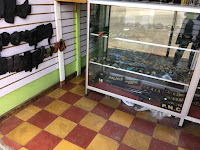
There was no proprietor visible, otherwise I would have asked whether this was an official store where officers bought their equipment, and whether they checked to see if the people making purchases were indeed police officers, or whether just anyone off the street - me, for example -could walk in and buy a PNC hat (just like you see people in the U.S. who are not necessarily police or firefighters wearing NYPD or NYFD logos).
I continued on to the Transmetro, and decided to walk through the Plaza de la Constitución, the main plaza in front of the National Cathedral and the Palacio Presidencial -- the presidential palace (the equivalent of the White House although I don't think the president actually resides there so not exactly equivalent). The plaza is a multivalent and multi-use space. On Sundays indigenous vendors from all over who have resettled in the capital set up booths and ply their wares, including clothing, toys, and food -- if you're looking for an inexpensive and "authentic" (whatever that means) bite on a Sunday afternoon or evening, you can get an assortment of Guatemalan street food -- boiled sweet potatoes (camotes), boiled and grilled corn, boiled güisquil (chayote), reheated plain tamales with black beans or chipilín, pupusas, tacos and other delights.
It is also a favored spot for demonstrations, for itinerant vendors hawking medicines, pushcart peddlers with sliced fruit.
 On this day, however, as I walked across the plaza I was startled by the sight of a large continent of people in military-style uniforms and bearing arms. I thought it was the army at first, but it turned out to be a group of environmental police, dressed in camouflage uniforms, with weapons, vests, and displaying some turtle shells and a cage possibly containing a live animal.
One officer was holding forth about how important it was to not throw litter, to protect Mother Nature, and so forth. There was a circle of people watching and sort of listening. A bouncy house for kids seemed to get getting some use, and there were two large inflatable very friendly-looking police officers --one male, and one female. Did I mention that the inflatable police were white - in a country where most people, not just those who identify as indigenous, are some shade of tan or brown? A little incongruous, to say the least. And one wonders why environmental police are so heavily armed. Surely not to protect rural campesinos and subsistence farmers whose lands and lives are threatened by environmentally destructive dams, mining operations and palm oil plantations, who are routinely killed (19 women land defenders so far in 2019) for trying to protect their lands.

So it was a bit jarring to go from the archives, which contain the gory details of how the police collaborated in torture, rape, forced disappearance, assassinations and mass killings, to a public display of the ostensibly benign and friendly face of the police (although the contrast between the smiling and unarmed inflatables and the battle-ready live policemen on the scene was notable). Bad cop/good cop indeed.
 But the ironies don't stop there. Right behind the environmental police's "meet and greet", there are two notable markers on the very surface of the plaza itself. Directly in front of the Palacio Nacional, now shrouded in black gauze for some reconstruction and repair work, the group H.I.J.O.S. -- founded by children of victims of the armed conflict -- has painted in immense yellow letters: "45,000. Donde están?" (45,000-- where are they). 45,000 is the statistic usually given for the number of forced disappearances (which as I noted in an earlier post, was the tactic used by the military and police in the cities, and it started long before the "scorched earth" policy of total destruction of communities and mass killings that many view as the characteristic of the armed conflict. H.I.J.O.S. is very active in Zona 1, the historic center of Guatemala City, and as I have noted in previous posts, they continually plaster the walls with blocks of flyers. I'm not sure if the poster on the left is theirs or from another group, but opposition groups make use of the walls of cafes, stores, and other businesses in Zona 1 to get their messages across.
 A little farther into the heart of the plaza is a memorial to another kind of mass killing: the deaths of 43 girls who were trapped in a fire at a shelter for abandoned or runaway children (well, it's more complicated than that but that will serve as a shorthand for the kind of shelter). The fire was on March 8, 2017, and on the 8th of every month women's groups and others hold a vigil in the Plaza. There is also graffiti painted on the pavement with the girls' names, and a small plaque set in the pavement as well. Now a somewhat more permanent set of markers has been added -- flowerpots filled with cement or sand, into which metal crosses have been inserted, each cross decorated with a small crocheted patch. It immediately called to mind a lot of feminist art practices that make use of "crafts" that are typically associated with women (and thus designated as "craft" and not as "art").

Both the ephemeral and the more permanent tell stories, sometimes the same stories in different registers, and at others different parts of the same story, or complementary or contrasting stories.
These silhouettes, now partially faded, remind me of a public art project I worked on in Atlanta 25 years ago, "Entering Buttermilk Bottom", marking a neighborhood that had been destroyed by urban renewal, an historically Black neighborhood. For one part of the project, we mapped out on the surface of the parking lot of the Atlantic Civic Center, the houses that had been demolished in order to make way for the Civic Center and its parking lot. When we went to talk to one of the directors of the Civic Center, to get permission to paint on the parking lot, we assured him that we had found a non-permanent paint that would adhere to the asphalt surface, but would fade away within several months. It turned out he was a former resident of the neighborhood, and said, "Oh, go ahead and use paint that will stay on as long as possible".

The story of how the archives came to be has been told but perhaps you haven't read it, so I'll summarize. Almost a decade after the war ended with the 1996 peace accords, in 2005, there was an important discovery. In an abandoned hospital building, decrepit and rat-infested (gotta include the "rat infested" part) that had belonged to the now-disbanded National Police (effectively an arm of the Guatemalan military during the war), someone discovered boxes upon boxes of moldering, dusty files. The Peace Accords had ostensibly paved the way for a public reckoning for the actions of the police and military during the war, but both had steadfastly claimed that they had kept no records of their activities. Well, we shouldn't be surprised that they were lying all along. There were approximately 80 million (yes, you read that right: 80,000,000) documents in the abandoned hospital, that turned out to be archives of the National Police dating back to the 1880s, providing ample documentation of massacres, forced disappearances, executions, and much more. Gotcha!
The archives have proven to be an invaluable resource for those dedicating to holding the material and intellectual authors of those war crimes accountable. Researchers, attorneys and others have used the material in the archives to support successful legal cases that have led to convictions of military commanders and others. Information in the National Police Archives was used in the genocide trial against former dictator Efraín Ríos Montt (convicted for genocide but the Constitutional Court overturned the conviction). The U.S. has also used information in the archives to track down war criminals who managed to relocate in the U.S., and in some cases send them back to face justice in Guatemala.
So the archives are kind of a big deal. And they have been under siege almost since their discovery -- by those forces who would prefer that the past remain buried and inaccessible. The U.S. has put money into their preservation. The University of Texas Austin, one of the major centers for Latin American studies in the U.S. and the host of massive physical and online archives in Latin American Studies, started to digitize the files. But recently, under the Morales administration, the attacks have stepped up. The former director of the archives was fired in 2018 by the United Nations program that had supported the archives. And most recently the Guatemalan government --specifically the Minister of the Interior, Enrique Degenhart, the guy who signed the "safe third country" agreement -- has moved to put the archives under the control of the National Civil Police and restrict access to the archives.

There were several buildings spread around a large field. There was a guard near the entrance and I explained where I was going and he escorted me to the archive building, which was around a bend. There were some abandoned police vehicles under a tree on the left-hand side, and there were brightly painted murals on some walls that set off the main archive building -- or at least the part that is open to the public. There were a couple of large modern sculptures on either side of the entrance, and the painted brick building did indeed look like the hospital it once was.
You can't just wander through rooms of file and poke around. In order to actually obtain information about a specific person or incident, you have to fill out a request -- you can do that online or by using a paper form you can get at the archive. The archive staff will then search through the databases they have and other files and let you know if they have found information about the person or the event you requested.
But they do have a small museum-like display in the reception area of the archive that traces some of the history that I've just laid out -- the discovery of the archives, the forensic work of clearing out the dirt, literally excavating the papers, retrieving and sorting and organizing the files. Part of the display recreates how the archives looked when they were discovered-- papers strewn all around, and then phase of archivists wearing gloves and masks sorting through the rubble, much like a rescue crew at a disaster site or a CSI team. There are reproductions of some of the materials found in the files, and some original equipment like an old typewriter and some furniture.
I spoke with a personable young woman who had worked at the archive when it was first discovered, and then had left to do other work, and had only returned two years ago. She explained the procedures to me, and asked if I wanted to put in a request. I explained that I wasn't actually looking for anyone -- although it did occur to me that one of my collaborators in New Bedford, who had lost family members in the conflicto armado, might want to look for information about his siblings who had been killed. I sent him a message and asked if he wanted to search, but he responded that thinking about that time was difficult for him. I took a copy of the request form nonetheless.

Outside, I spent some time looking at the murals that were painted on the walls. One long mural started from the left with a portrait of a benevolent Monseñor Gerardi, the archbishop of Guatemala City who led one of the truth commissions after the war and was assassinated two days after the publication of the report he co-authored. The next part of the mural contains scenes of "before" -- a Mayan pyramid, ears of corn, a woman kneeling before a backstrap loom in front of a forested landscape, a cooking fire burning. And then a small crowd of people holding signs and banners at a protest, asking for "Justicia" (justice). There is an image of a soldier's boot looming over this peaceful landscape.

Unlike some other murals I've seen about the war -- I'll talk in a future post about the murals on the walls of the cloister that forms part of the Parroquia (parish) in Zacualpa, Quiché -- there is no imagery that directly references the destruction and death of the armed conflict. There are scenes that indicate the process of rebuilding and flourishing in the "after" part -- generally, in the several murals I've seen, there is a historical progression from left to right, and the panels farthest to the right indicate the present or a bright and hopeful path for the future. The last panel on this particular mural shows children with their arms outstretched and a large aquatic creature (medusa? octopus?) floating horizontally in the foreground.

The words are "Memoria" (memory) and "Vida" (life). Memory is life, life is memory. Memory is constructed out of bricks, and birds are flying overhead.
There are some other murals on the other side of the entrance but they were partially obscured by the parked police vehicles. One (visible above, on the farthest left hand panel) shows some skulls, and obviously reflects the unearthing of the bodies of massacre victims.
I made my way back out to the street and walked a few blocks to get to the Transmetro stop. I was surprised to pass a small shop selling police gear: guns, hats, vests and other military/police paraphernalia.
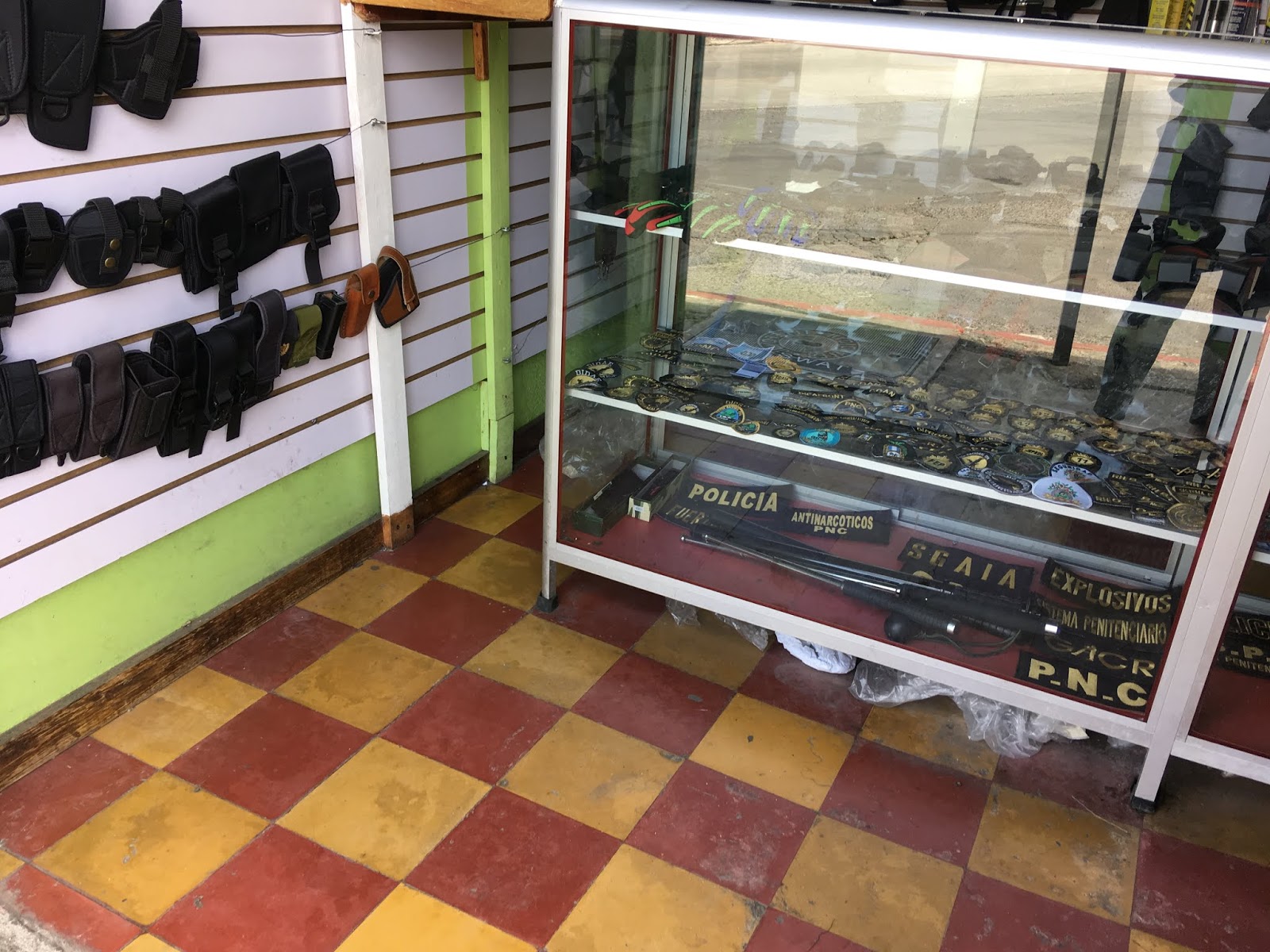
There was no proprietor visible, otherwise I would have asked whether this was an official store where officers bought their equipment, and whether they checked to see if the people making purchases were indeed police officers, or whether just anyone off the street - me, for example -could walk in and buy a PNC hat (just like you see people in the U.S. who are not necessarily police or firefighters wearing NYPD or NYFD logos).
I continued on to the Transmetro, and decided to walk through the Plaza de la Constitución, the main plaza in front of the National Cathedral and the Palacio Presidencial -- the presidential palace (the equivalent of the White House although I don't think the president actually resides there so not exactly equivalent). The plaza is a multivalent and multi-use space. On Sundays indigenous vendors from all over who have resettled in the capital set up booths and ply their wares, including clothing, toys, and food -- if you're looking for an inexpensive and "authentic" (whatever that means) bite on a Sunday afternoon or evening, you can get an assortment of Guatemalan street food -- boiled sweet potatoes (camotes), boiled and grilled corn, boiled güisquil (chayote), reheated plain tamales with black beans or chipilín, pupusas, tacos and other delights.
It is also a favored spot for demonstrations, for itinerant vendors hawking medicines, pushcart peddlers with sliced fruit.

One officer was holding forth about how important it was to not throw litter, to protect Mother Nature, and so forth. There was a circle of people watching and sort of listening. A bouncy house for kids seemed to get getting some use, and there were two large inflatable very friendly-looking police officers --one male, and one female. Did I mention that the inflatable police were white - in a country where most people, not just those who identify as indigenous, are some shade of tan or brown? A little incongruous, to say the least. And one wonders why environmental police are so heavily armed. Surely not to protect rural campesinos and subsistence farmers whose lands and lives are threatened by environmentally destructive dams, mining operations and palm oil plantations, who are routinely killed (19 women land defenders so far in 2019) for trying to protect their lands.

So it was a bit jarring to go from the archives, which contain the gory details of how the police collaborated in torture, rape, forced disappearance, assassinations and mass killings, to a public display of the ostensibly benign and friendly face of the police (although the contrast between the smiling and unarmed inflatables and the battle-ready live policemen on the scene was notable). Bad cop/good cop indeed.
 But the ironies don't stop there. Right behind the environmental police's "meet and greet", there are two notable markers on the very surface of the plaza itself. Directly in front of the Palacio Nacional, now shrouded in black gauze for some reconstruction and repair work, the group H.I.J.O.S. -- founded by children of victims of the armed conflict -- has painted in immense yellow letters: "45,000. Donde están?" (45,000-- where are they). 45,000 is the statistic usually given for the number of forced disappearances (which as I noted in an earlier post, was the tactic used by the military and police in the cities, and it started long before the "scorched earth" policy of total destruction of communities and mass killings that many view as the characteristic of the armed conflict. H.I.J.O.S. is very active in Zona 1, the historic center of Guatemala City, and as I have noted in previous posts, they continually plaster the walls with blocks of flyers. I'm not sure if the poster on the left is theirs or from another group, but opposition groups make use of the walls of cafes, stores, and other businesses in Zona 1 to get their messages across.

Both the ephemeral and the more permanent tell stories, sometimes the same stories in different registers, and at others different parts of the same story, or complementary or contrasting stories.
These silhouettes, now partially faded, remind me of a public art project I worked on in Atlanta 25 years ago, "Entering Buttermilk Bottom", marking a neighborhood that had been destroyed by urban renewal, an historically Black neighborhood. For one part of the project, we mapped out on the surface of the parking lot of the Atlantic Civic Center, the houses that had been demolished in order to make way for the Civic Center and its parking lot. When we went to talk to one of the directors of the Civic Center, to get permission to paint on the parking lot, we assured him that we had found a non-permanent paint that would adhere to the asphalt surface, but would fade away within several months. It turned out he was a former resident of the neighborhood, and said, "Oh, go ahead and use paint that will stay on as long as possible".
Wednesday, July 31, 2019
Historical memory research, part 2
Once I had determined to write about historical memory, I had to figure out which sites I was going to focus on. There were well over 600 documented massacres (the number that has stuck in my mind is 644, but that's from several years ago, and there may have been more unearthed since then. The massacres mostly took place in rural areas in the highlands (altiplano), far away from the capital and major cities. While the army operated in the cities, they didn't carry out large-scale military operations there.
The counterinsurgency strategy, laid out in a series of plans that were written out and therefore discovered later on -- two of the most notorious were Plan Sofia and Plan Victoria 82 -- was to eradicate Mayan villages, on the assumption that the Maya were all either guerrillas or guerrilla sympathizers (not actually the case). In counterinsurgency scripts that resemble some of those used by the U.S. in Vietnam, the army targeted specific villages. In some cases they picked off individuals who had been named as suspected guerrillas (they usually tried to find a local person who was willing to name names, and then targeted those individuals, usually torturing them first and then killing them). In others they rounded up all the inhabitants of a village, separating men and women. Sometimes they forced the men to dig their own graves. Often they cordoned the women and girls off and raped them before killing them. Or sometimes they just raped them. Other times the women were forced to be sex slaves for the soldiers; much of this has been detailed in books like Victor Montejo´'s memoir, Father Ricardo Falla's word, Victoria Sanford's Buried Secrets, and many other sources published in Guatemala. The sexual violence was laid out in detail during the genocide trial of former dictator José Efraín Ríos Montt, when Maya Ixil women who were survivors of sexual violence testified publicly, and later in the Sepur Zarco trial (the name of a military encampment) when Maya Q'eq'chi women told their stories.
In many instances entire villages were destroyed. The army burned houses and crops, and killed livestock. The campaigns were anything but random; they were highly systematic, unlike the sporadic army incursions of prior years. Villagers often managed to flee to the surrounding hills and forests; some went farther and ended up living for years in organized Comunidades Populares de Resistencia (popular or people's resistance communities), usually abbreviated as CPRs. The CPRs were located in relatively remote areas like the sparsely populated Ixcán -- a region in the northeastern part of el Quiché -- or in the mountains. Jumping ahead a bit, I spoke to several people who fled their villages in the early 1980s during the massacres, and didn't return until after the Peace Accords were signed, meaning that they lived in the CPRs for 14, 15 or 16 years (depending upon when they fled and how quickly they were able to return after peace was declared.
The army's strategy in the cities was different, and it began earlier than the campaign of massacres. What happened in the cities were forced disappearances and assassinations, usually of individuals (although sometimes more than one person was killed). The army or military police broke into people's homes and whisked them away, or grabbed people off the street. University students, teachers, trade unionists, activists were among the targets. About two years ago I started to visit the places in Guatemala City where there were plaques marking sites where people had been disappeared or assassinated.
For this trip, I decided to look at memory sites in rural areas where massacres had occurred. But there are dozens of sites, and so I had to figure out how to narrow it down so that I could write a reasonably coherent 20-page article (somewhere in that ballpark).
As luck would have it, in early June I got a couple of text messages from colleagues who do human rights work in Guatemala, telling me that there were two indigenous leaders from Guatemala visiting the U.S. who needed a place to stay in New York. I already had a house guest but said that as long as they didn't mind having a slightly crowded place and sharing a fold-out sofa bed, and weren't allergic to cats, I would be happy to host.
And so don Miguel de León from Nebaj and don Marvin (I didn't get his last name) from the Garifuna community in Livingston came to stay with me for several days. We had some opportunities to talk during that time. Both were leading members of what are generally referred to as "autoridades ancestrales" (ancestral authorities) in Guatemala. Miguel was a member of the alcaldía indígena (indigenous mayoralty) in Nebaj. Both urged me to come visit them when I was in Guatemala. But it really wasn't until they had left, and I started to plot out my trip to Guatemala, that I realized that I might want to include Nebaj as one of the places I focused on for this article.
During the genocide trial in 2013-2014, some of the most convincing evidence against Ríos Montt was the testimony provided by Ixil women from Nebaj who laid out in detail how they had been gang raped by soldiers during the military incursions into the Ixil region. Their testimony was especially gripping because in general, in Maya culture, one does not discuss intimate matters, matters having to do with sex, in public, and especially not in a courtroom where the proceedings are being transmitted internationally via social media. Sex is one of those things "de eso no se habla" (you don't talk about that). Tens of thousands, perhaps more, women and girls had been raped during the armed conflict. But for the most part no one talked about it. Being raped is a matter of shame. Obviously many of the rape victims were also killed so there was no danger of their revealing their stories. Rape shames not only the victim herself but her family -- this is why the army often raped women in front of their families, to humiliate the family, terrorize them and buy their silence. The mother of a good friend was raped in front of her children; her husband was not present and she begged the children not to tell him. I think they never did. She also asked my friend to not talk about the matter until she was dead (he didn't keep that promise; he ended up in the United States and when he sough asylum, he told the story to the attorneys and the immigration judge).
So it was stunning that the Ixil women had decided to break the silence in an extremely public setting. They covered their faces with their shawls when they spoke, and turned away from the accused, who was sitting in the courtroom with headphones, as the women spoke in Ixil and their words had to be translated for the defendant.
I hadn't previously considered traveling to the Ixil region to look at monuments and markers because with the exception of one friend who has had to move away for work, I didn't really know anyone there, and I know from experience that you don't just walk into a region where there were massacres as an unknown person and start asking people about the genocide. But since don Miguel was part of the indigenous mayoralty in Nebaj, if he were supportive of my project, then I would be able to proceed.
A colleague, with whom I was co-organizing a conference in July for the Guatemala Scholars Network, had suggested that I visit a community museum in Rabinal, a municipality in Baja Verapaz in the eastern part of the country, where there had been several massacres during the conflict, so I put that on the list.
The other site I decided to include was Zacualpa, which was my first experience of memory sites in Guatemala. It has been several years since I've visited the department of Quiché, where I had lived in 2011 during my Fulbright. I'd visited the chapels in the church cloister a few times but hadn't really "investigated" them -- that is, I hadn't looked at them with a researcher's eye, hadn't taken notes.
And of course I would look at some of the sites in the capital that I had noted before - the numerous plaques and markers in the Zona 1 that mostly go unnoticed by passersby, as well as the street posters and the two small museums that I had visited previously but again, hadn't really "researched."
The counterinsurgency strategy, laid out in a series of plans that were written out and therefore discovered later on -- two of the most notorious were Plan Sofia and Plan Victoria 82 -- was to eradicate Mayan villages, on the assumption that the Maya were all either guerrillas or guerrilla sympathizers (not actually the case). In counterinsurgency scripts that resemble some of those used by the U.S. in Vietnam, the army targeted specific villages. In some cases they picked off individuals who had been named as suspected guerrillas (they usually tried to find a local person who was willing to name names, and then targeted those individuals, usually torturing them first and then killing them). In others they rounded up all the inhabitants of a village, separating men and women. Sometimes they forced the men to dig their own graves. Often they cordoned the women and girls off and raped them before killing them. Or sometimes they just raped them. Other times the women were forced to be sex slaves for the soldiers; much of this has been detailed in books like Victor Montejo´'s memoir, Father Ricardo Falla's word, Victoria Sanford's Buried Secrets, and many other sources published in Guatemala. The sexual violence was laid out in detail during the genocide trial of former dictator José Efraín Ríos Montt, when Maya Ixil women who were survivors of sexual violence testified publicly, and later in the Sepur Zarco trial (the name of a military encampment) when Maya Q'eq'chi women told their stories.
In many instances entire villages were destroyed. The army burned houses and crops, and killed livestock. The campaigns were anything but random; they were highly systematic, unlike the sporadic army incursions of prior years. Villagers often managed to flee to the surrounding hills and forests; some went farther and ended up living for years in organized Comunidades Populares de Resistencia (popular or people's resistance communities), usually abbreviated as CPRs. The CPRs were located in relatively remote areas like the sparsely populated Ixcán -- a region in the northeastern part of el Quiché -- or in the mountains. Jumping ahead a bit, I spoke to several people who fled their villages in the early 1980s during the massacres, and didn't return until after the Peace Accords were signed, meaning that they lived in the CPRs for 14, 15 or 16 years (depending upon when they fled and how quickly they were able to return after peace was declared.
The army's strategy in the cities was different, and it began earlier than the campaign of massacres. What happened in the cities were forced disappearances and assassinations, usually of individuals (although sometimes more than one person was killed). The army or military police broke into people's homes and whisked them away, or grabbed people off the street. University students, teachers, trade unionists, activists were among the targets. About two years ago I started to visit the places in Guatemala City where there were plaques marking sites where people had been disappeared or assassinated.
For this trip, I decided to look at memory sites in rural areas where massacres had occurred. But there are dozens of sites, and so I had to figure out how to narrow it down so that I could write a reasonably coherent 20-page article (somewhere in that ballpark).
As luck would have it, in early June I got a couple of text messages from colleagues who do human rights work in Guatemala, telling me that there were two indigenous leaders from Guatemala visiting the U.S. who needed a place to stay in New York. I already had a house guest but said that as long as they didn't mind having a slightly crowded place and sharing a fold-out sofa bed, and weren't allergic to cats, I would be happy to host.
And so don Miguel de León from Nebaj and don Marvin (I didn't get his last name) from the Garifuna community in Livingston came to stay with me for several days. We had some opportunities to talk during that time. Both were leading members of what are generally referred to as "autoridades ancestrales" (ancestral authorities) in Guatemala. Miguel was a member of the alcaldía indígena (indigenous mayoralty) in Nebaj. Both urged me to come visit them when I was in Guatemala. But it really wasn't until they had left, and I started to plot out my trip to Guatemala, that I realized that I might want to include Nebaj as one of the places I focused on for this article.
During the genocide trial in 2013-2014, some of the most convincing evidence against Ríos Montt was the testimony provided by Ixil women from Nebaj who laid out in detail how they had been gang raped by soldiers during the military incursions into the Ixil region. Their testimony was especially gripping because in general, in Maya culture, one does not discuss intimate matters, matters having to do with sex, in public, and especially not in a courtroom where the proceedings are being transmitted internationally via social media. Sex is one of those things "de eso no se habla" (you don't talk about that). Tens of thousands, perhaps more, women and girls had been raped during the armed conflict. But for the most part no one talked about it. Being raped is a matter of shame. Obviously many of the rape victims were also killed so there was no danger of their revealing their stories. Rape shames not only the victim herself but her family -- this is why the army often raped women in front of their families, to humiliate the family, terrorize them and buy their silence. The mother of a good friend was raped in front of her children; her husband was not present and she begged the children not to tell him. I think they never did. She also asked my friend to not talk about the matter until she was dead (he didn't keep that promise; he ended up in the United States and when he sough asylum, he told the story to the attorneys and the immigration judge).
So it was stunning that the Ixil women had decided to break the silence in an extremely public setting. They covered their faces with their shawls when they spoke, and turned away from the accused, who was sitting in the courtroom with headphones, as the women spoke in Ixil and their words had to be translated for the defendant.
I hadn't previously considered traveling to the Ixil region to look at monuments and markers because with the exception of one friend who has had to move away for work, I didn't really know anyone there, and I know from experience that you don't just walk into a region where there were massacres as an unknown person and start asking people about the genocide. But since don Miguel was part of the indigenous mayoralty in Nebaj, if he were supportive of my project, then I would be able to proceed.
A colleague, with whom I was co-organizing a conference in July for the Guatemala Scholars Network, had suggested that I visit a community museum in Rabinal, a municipality in Baja Verapaz in the eastern part of the country, where there had been several massacres during the conflict, so I put that on the list.
The other site I decided to include was Zacualpa, which was my first experience of memory sites in Guatemala. It has been several years since I've visited the department of Quiché, where I had lived in 2011 during my Fulbright. I'd visited the chapels in the church cloister a few times but hadn't really "investigated" them -- that is, I hadn't looked at them with a researcher's eye, hadn't taken notes.
And of course I would look at some of the sites in the capital that I had noted before - the numerous plaques and markers in the Zona 1 that mostly go unnoticed by passersby, as well as the street posters and the two small museums that I had visited previously but again, hadn't really "researched."
Saturday, July 27, 2019
Let's stop calling them "chicken buses"
This post was prompted by a question from a friend on a post I had published on Facebook, complaining about uncomfortable bus rides. The ride this morning from Nebaj, in the northern part of Quiché, to the city of Cobán in the department of Alta Verapaz, was particularly bad. I got to the gas station from which the bus departs before the bus had emerged from its parking spot, but the friend who was accompanying me held back for a moment when the bus pulled out, and two men who had arrived after me rushed onto the bus and got better seats (seats not over the wheels). Although this was what Guatemalans call a coaster -- a slightly roomier van than a mini-van, with a higher ceiling, and thus slightly higher class than what is classified as a microbus-- it quickly got very crowded, and ended up carrying twice as many people as there were original seats. Bus owners add extra fold-down seats, so that there is a solid row of seating from wall to wall with no aisle; when someone wants to get to one of the back rows, or get to the door to leave, the people sitting in the fold-down seats have to get up. Very often there are women with babies or adults of both sexes with young children. In a typical coaster row, there are two seats on the LH side of the aisle and a single seat on the RH side, but today the driver's assistant (more about them later) made us squeeze in 5 people across, with children or babies on laps making 6 people across. Forget about seat belts or baby seats; the former are of no concern to the bus drivers/owners, and the latter are beyond the means of the poor rural folks who have no choice put to crowd onto these buses.
As much as I might grumble about having to be literally squished between people, and as resentful as I am of the ayudantes (assistants) who, no matter how cramped and crowded the bus in, insist upon squeezing even more people in, assuring people who are waiting along the road that there is room, I understand why people who live in rural areas where there might only be a few buses a day will cram onto a bus where they are not going to get a seat, and will spend a couple of hours standing, trying not to lose their balance and crush their babies or other passengers as the bus swerves around treacherous hairpin turns in the mountains, or lurches along dirt roads covered with gravel as the bus moves beyond where the pavement ends.
The route I was traveling today, from Nebaj to Cobán, is traversed by precisely one bus a day, that leaves from a gas station in Nebaj supposedly at 5:00 a.m. (my most gracious host and I were alternately told that the bus was at 4:45 and at 5, so we made sure we were at the gas station before 4:45). The bus winds its way southward down steep roads to the town of Cunén, and then picks up the east-west highway (although that word is only applicable for part of the distance) that connects Quiché and Alta Verapaz. Possibly there is more frequent bus service between Cunén and Cobán, but there were a lot of people who filled up the seats that emptied as people got off at Cunén.
In addition to the overcrowding (there were about 32 people on the bus at its peak this morning, with 2 young men half-hanging out the open door), it seems to be obligatory for bus drivers to play loud music for the entire bus ride. Today's driver had his radio tuned to some station or playlist from El Salvador that promoted itself as a station for los microbuseros (microbus drivers), which played a pretty non-descript mix -- I don't remember anything much other than rancheras and duranguenses, but it was loud enough to prevent me from catching any rest.
The lack of sanitary facilities kept me from dipping into my water bottle -- I was told there would be a stop in Uspantán -- Rigoberta Menchú's home municipality, for what that's worth -- but the driver said we were behind and he stopped for precisely 4 minutes in Uspantán, not enough time to risk the effort. There was a slightly longer stop in Chicamán, but I wasn't sure how long the stop was going to last and there was no public restroom visible. I had hoped to eat an actual breakfast on the road -- there are generally comedores where the buses stop, but the one comedor I tried in Chicamán told me that they wouldn't be able to make me eggs before the bus left. Really? Scrambled eggs takes all of a few minutes to make and presumably they already have the tortillas and beans ready. But I wasn't going to argue. The woman could have made 4 plates of scrambled eggs in the time it took me to walk around the few "stalls" (they weren't really stalls) around the park where women were serving up cold cereal (corn flakes and some variant of Fruit Loops seem to be popular) and small dense tamales called chuchitos (wrapped in dried corn husks rather than fresh leaves), and find someone who was able to change a Q20 note. One of the persistent problems with street food in Guatemala is that vendors never have change. And so the first woman I spoke to, whose chuchitos actually looked better than the one I ended up buying, lost the sale because she didn't have change (and neither did I -- I end up using all my change when I have to buy something in a small store or on the street).
But I'm getting away from the reason I started this blog post. It wasn't really to tell you about my trip from Nebaj to Cobán -- which ended up taking quite a big longer than I had been told -- but to ask that we (and by that I mean folks from the U.S.) stop using the term "chicken bus".
As I was saying back up at the top, this post was prompted by a friend's question about my bus ride: "Were there any chickens?" I explained that people don't usually bring live poultry onto long-distance buses, and that I've only occasionally seen people with live poultry on local buses in rural areas -- and by "local" I don't mean intra-urban, but buses that connect the town center with the outlying hamlets.A lot of people travel from rural hamlets into the nearby towns for market day, and while there is plenty of already-slaughtered meat and poultry available at markets, there are also usually people selling live poultry. Gallinas criollas (the equivalent to "pastured" or "free range" chickens) are a delicacy for folks who don't have their own, and people often prefer to buy the poultry live and slaughter it themselves. So logically if you buy a live chicken or duck or goose, you pop it into a bag and bring it home with you.
But then I started to think about the term "chicken bus" which I mentioned in my most recent blog post, and realized that it's a problematic term. We use it in a disparaging way, even if we mean it as a joke. In much of the world, people still raise poultry and livestock in their homes or yards. I don't mean big industrial farms, but subsistence farmers throughout the world. Even in major cities like New York, in some ethnic enclaves (South Bronx, parts of Brooklyn, probably Queens, and in some of the Chinatowns) it's possible to buy live poultry and either have it slaughtered for you, or slaughter it yourself. It's unremarkable. It's not exotic, or strange, or a curiosity. It's very quotidian. But labeling the buses that are the only transportation available for people in rural areas in the so-called developing world "chicken buses" serves to exoticize and, although not always intentionally, disparage and demean the people for whom there's nothing out of the ordinary about purchasing live animals and bringing them home on the only means of transport available. I think it also dehumanizes the people who use those buses also. The subtext is, "Oh, those poor unfortunate souls who have to share their transportation with animals. Thank goodness we don't have to do that." No, because you (the person who uses the term "chicken bus") can go to an air-conditioned supermarket where the chickens are already slaughtered, cleaned, cut up and packaged in styrofoam and plastic wrap (or maybe you go to a ecologically conscious market that doesn't use styrofoam). Well, for much of human history we humans lived with animals, and people still do in some parts of the world (less so now than previously, as urbanization, migration, monocultures and biofuels undermine subsistence farming and rural lifeways). There's a famous serious of ethnographic documentaries about the Turkana in eastern African by filmmakers Judith and David MacDougall called Living with Herds. We make the people in Africa, Asia and Latin America who still have a more direct relationship with live animals somehow lesser than us by referring to their transportation in this way. And we elide the humans by labeling the buses by their occasional avian passengers.
As I noted in the previous post, Guatemalans don't use the term "chicken bus" and when I started to explain the term and what it signifies to North Americans, I was met with slightly puzzled looks. People here categorize buses by the routes they travel, and the kind of vehicle -- converted school bus, mini-van, or fancier bus. Bringing a basket or a bag of poultry onto a bus isn't the distinguishing or defining characteristic, since people can and do bring live poultry onto all of these kinds of buses except the fancy ones with reserved seats depending upon where the bus is going and what else might be available.
So enough with "chicken bus". At least in my company.
As much as I might grumble about having to be literally squished between people, and as resentful as I am of the ayudantes (assistants) who, no matter how cramped and crowded the bus in, insist upon squeezing even more people in, assuring people who are waiting along the road that there is room, I understand why people who live in rural areas where there might only be a few buses a day will cram onto a bus where they are not going to get a seat, and will spend a couple of hours standing, trying not to lose their balance and crush their babies or other passengers as the bus swerves around treacherous hairpin turns in the mountains, or lurches along dirt roads covered with gravel as the bus moves beyond where the pavement ends.
The route I was traveling today, from Nebaj to Cobán, is traversed by precisely one bus a day, that leaves from a gas station in Nebaj supposedly at 5:00 a.m. (my most gracious host and I were alternately told that the bus was at 4:45 and at 5, so we made sure we were at the gas station before 4:45). The bus winds its way southward down steep roads to the town of Cunén, and then picks up the east-west highway (although that word is only applicable for part of the distance) that connects Quiché and Alta Verapaz. Possibly there is more frequent bus service between Cunén and Cobán, but there were a lot of people who filled up the seats that emptied as people got off at Cunén.
In addition to the overcrowding (there were about 32 people on the bus at its peak this morning, with 2 young men half-hanging out the open door), it seems to be obligatory for bus drivers to play loud music for the entire bus ride. Today's driver had his radio tuned to some station or playlist from El Salvador that promoted itself as a station for los microbuseros (microbus drivers), which played a pretty non-descript mix -- I don't remember anything much other than rancheras and duranguenses, but it was loud enough to prevent me from catching any rest.
The lack of sanitary facilities kept me from dipping into my water bottle -- I was told there would be a stop in Uspantán -- Rigoberta Menchú's home municipality, for what that's worth -- but the driver said we were behind and he stopped for precisely 4 minutes in Uspantán, not enough time to risk the effort. There was a slightly longer stop in Chicamán, but I wasn't sure how long the stop was going to last and there was no public restroom visible. I had hoped to eat an actual breakfast on the road -- there are generally comedores where the buses stop, but the one comedor I tried in Chicamán told me that they wouldn't be able to make me eggs before the bus left. Really? Scrambled eggs takes all of a few minutes to make and presumably they already have the tortillas and beans ready. But I wasn't going to argue. The woman could have made 4 plates of scrambled eggs in the time it took me to walk around the few "stalls" (they weren't really stalls) around the park where women were serving up cold cereal (corn flakes and some variant of Fruit Loops seem to be popular) and small dense tamales called chuchitos (wrapped in dried corn husks rather than fresh leaves), and find someone who was able to change a Q20 note. One of the persistent problems with street food in Guatemala is that vendors never have change. And so the first woman I spoke to, whose chuchitos actually looked better than the one I ended up buying, lost the sale because she didn't have change (and neither did I -- I end up using all my change when I have to buy something in a small store or on the street).
But I'm getting away from the reason I started this blog post. It wasn't really to tell you about my trip from Nebaj to Cobán -- which ended up taking quite a big longer than I had been told -- but to ask that we (and by that I mean folks from the U.S.) stop using the term "chicken bus".
As I was saying back up at the top, this post was prompted by a friend's question about my bus ride: "Were there any chickens?" I explained that people don't usually bring live poultry onto long-distance buses, and that I've only occasionally seen people with live poultry on local buses in rural areas -- and by "local" I don't mean intra-urban, but buses that connect the town center with the outlying hamlets.A lot of people travel from rural hamlets into the nearby towns for market day, and while there is plenty of already-slaughtered meat and poultry available at markets, there are also usually people selling live poultry. Gallinas criollas (the equivalent to "pastured" or "free range" chickens) are a delicacy for folks who don't have their own, and people often prefer to buy the poultry live and slaughter it themselves. So logically if you buy a live chicken or duck or goose, you pop it into a bag and bring it home with you.
But then I started to think about the term "chicken bus" which I mentioned in my most recent blog post, and realized that it's a problematic term. We use it in a disparaging way, even if we mean it as a joke. In much of the world, people still raise poultry and livestock in their homes or yards. I don't mean big industrial farms, but subsistence farmers throughout the world. Even in major cities like New York, in some ethnic enclaves (South Bronx, parts of Brooklyn, probably Queens, and in some of the Chinatowns) it's possible to buy live poultry and either have it slaughtered for you, or slaughter it yourself. It's unremarkable. It's not exotic, or strange, or a curiosity. It's very quotidian. But labeling the buses that are the only transportation available for people in rural areas in the so-called developing world "chicken buses" serves to exoticize and, although not always intentionally, disparage and demean the people for whom there's nothing out of the ordinary about purchasing live animals and bringing them home on the only means of transport available. I think it also dehumanizes the people who use those buses also. The subtext is, "Oh, those poor unfortunate souls who have to share their transportation with animals. Thank goodness we don't have to do that." No, because you (the person who uses the term "chicken bus") can go to an air-conditioned supermarket where the chickens are already slaughtered, cleaned, cut up and packaged in styrofoam and plastic wrap (or maybe you go to a ecologically conscious market that doesn't use styrofoam). Well, for much of human history we humans lived with animals, and people still do in some parts of the world (less so now than previously, as urbanization, migration, monocultures and biofuels undermine subsistence farming and rural lifeways). There's a famous serious of ethnographic documentaries about the Turkana in eastern African by filmmakers Judith and David MacDougall called Living with Herds. We make the people in Africa, Asia and Latin America who still have a more direct relationship with live animals somehow lesser than us by referring to their transportation in this way. And we elide the humans by labeling the buses by their occasional avian passengers.
As I noted in the previous post, Guatemalans don't use the term "chicken bus" and when I started to explain the term and what it signifies to North Americans, I was met with slightly puzzled looks. People here categorize buses by the routes they travel, and the kind of vehicle -- converted school bus, mini-van, or fancier bus. Bringing a basket or a bag of poultry onto a bus isn't the distinguishing or defining characteristic, since people can and do bring live poultry onto all of these kinds of buses except the fancy ones with reserved seats depending upon where the bus is going and what else might be available.
So enough with "chicken bus". At least in my company.
Thursday, July 25, 2019
Lagniappe: country of contradictions
I know that those of you who have been reading my blog over the years may find some of this repetitive, but each time I come to Guatemala I am struck by the many contradictions --between how the privileged sectors live, and how the rest of the population lives, between official rhetoric and reality, between urban life and the vast expanse of the country where the majority of the population lives that is lumped together under the label of la area rural. Of course there isn't one single "rural area"; while there are some common features to life in rural Guatemala (official neglect, deep-seated poverty, lack of services, underfunded schools and hospitals, crumbling or non-existent infrastructure -- and by this I mean sections of highways that literally collapse, droughts that have gone on for years, chronic malnutrition) it's also a mistake to not understand some of the particularities of different areas of the country (those that have seen foreign investment in export-oriented plantation agriculture, those that have ravaged by the expansion of biofuels, particularly palma africana, those that have seen mining and hydroelectric licenses granted).
One small example -- and this is absolutely a "First World problem" is the difference in the types of bus service available, depending upon where you are heading. If you are heading to one of the popular tourist destinations, such as Panajachel, Antigua, Chichicastenango or Xela, you can ride in a fairly comfortable air-conditioned shuttle (usually seating 15-20 people). There are also "first class" and "second class" full-sized buses that travel between Guatemala City and Huehuetenango (not quite sure why Huehue gets nice buses and Xela doesn't), and a few other destinations. These leave from the bus company's headquarters, you get a reserved seat, there are bathrooms on the first-class buses, and the bus makes a 20-minute meal stop about halfway through. There are baggage compartments underneath (like in a Greyhound or even Bolt bus in the U.S.), and the seats are fairly comfortable. The buses generally only drop passengers off at the company's terminal at the other destination, or occasionally they will drop someone off at the main bus terminal if he or she has to make a connection to an ordinary bus or van.
Of course, there are what we Americans typically call "chicken buses" that go to these same locations -- converted school buses that typically squeeze three adults into seats designed for two children, sometimes four, with people standing in the aisles. Baggage gets strapped on top of the bus (sometimes there are tarps pulled over if it rains but they don't always cover everything). Guatemalans call them camionetas or buses de parrilla (buses with a rack).There are no bathrooms, no bathroom stops. Vendors get on the bus before it pulls out of the terminal (which is really just an open area with buses and vans jumbled around and hawkers calling out trying to gather passengers for whichever driver is paying them) with trays of fruit, tamales, sandwiches, bags of nuts. Some are hawking vitamins or when it stops in one of the cities along the route buses stop pretty much when a passenger calls out that he or she wants to get off, or when someone standing on the side of the road flags a bus to stop.
By contrast, if you are traveling from Guatemala City to anywhere in Quiché other than Chichicastenango, you have no choice but to ride a camioneta. There aren't other options. Which says something about how some parts of the country are viewed from the standpoint of the capital city, and the companies that run the exclusive bus lines.
One small example -- and this is absolutely a "First World problem" is the difference in the types of bus service available, depending upon where you are heading. If you are heading to one of the popular tourist destinations, such as Panajachel, Antigua, Chichicastenango or Xela, you can ride in a fairly comfortable air-conditioned shuttle (usually seating 15-20 people). There are also "first class" and "second class" full-sized buses that travel between Guatemala City and Huehuetenango (not quite sure why Huehue gets nice buses and Xela doesn't), and a few other destinations. These leave from the bus company's headquarters, you get a reserved seat, there are bathrooms on the first-class buses, and the bus makes a 20-minute meal stop about halfway through. There are baggage compartments underneath (like in a Greyhound or even Bolt bus in the U.S.), and the seats are fairly comfortable. The buses generally only drop passengers off at the company's terminal at the other destination, or occasionally they will drop someone off at the main bus terminal if he or she has to make a connection to an ordinary bus or van.
Of course, there are what we Americans typically call "chicken buses" that go to these same locations -- converted school buses that typically squeeze three adults into seats designed for two children, sometimes four, with people standing in the aisles. Baggage gets strapped on top of the bus (sometimes there are tarps pulled over if it rains but they don't always cover everything). Guatemalans call them camionetas or buses de parrilla (buses with a rack).There are no bathrooms, no bathroom stops. Vendors get on the bus before it pulls out of the terminal (which is really just an open area with buses and vans jumbled around and hawkers calling out trying to gather passengers for whichever driver is paying them) with trays of fruit, tamales, sandwiches, bags of nuts. Some are hawking vitamins or when it stops in one of the cities along the route buses stop pretty much when a passenger calls out that he or she wants to get off, or when someone standing on the side of the road flags a bus to stop.
By contrast, if you are traveling from Guatemala City to anywhere in Quiché other than Chichicastenango, you have no choice but to ride a camioneta. There aren't other options. Which says something about how some parts of the country are viewed from the standpoint of the capital city, and the companies that run the exclusive bus lines.
Sunday, July 21, 2019
Historical memory: the research part of this trip
About two years ago, maybe more, I became interested in the ways in which the genocide was marked (or not) in public space. This interest has its roots in my work with an artists' collective called REPOhistory starting in the late 1980s; we began to explore and document the histories that were ignored, marginalized, or absent, and create alternative historical markers. This interest in what is, and what is not, represented in museums, markers and monuments has been a simmering undercurrent for a long time.
In one of my first trips to Guatemala, or maybe it was when I was living here in 2011, I visited the parish in Zacualpa, and the nun who was then more or less in charge of things, Sister Ana Maria Álvarez (she is no longer at the parish in Zacualpa but spent a few years in Africa, and now has been reassigned somewhere else) took me to a chapel that had been used as a torture and killing chamber, and that the parish had decided to preserve as a memory site. On the ceiling beams, there were brass doorhandles that had been used to suspend torture victims by their hands, and community members had made small wooden crosses with the names and dates of their loved ones who had perished. One of the floor stones had been removed and there was a small hole in the earth beneath, where some remains had been found. Sor Ana Maria pointed out some faint reddish-brown streaks on the walls, and told me that those were bloody handprints. She told me that after the war, a group of volunteers from Italy had come and helped re-establish the church, and that some of the volunteers in their zeal had started to clean the bloodstains from the wall, but someone stopped them before they were able to completely eradicate the traces.
There was another small chapel farther back in the cloister, but I don't remember as much about that from my earlier visit (I'm trying not to bleed in my record of what I saw today). There were also some murals and photos on the walls of the cloister-- I'm not really sure what to call it -- it's the place where the nuns and lay sisters who staff the parish most of the time live. Cloister? Convent? It is not closed off to the public -- in addition to the sisters' living quarters and offices, there are classrooms and dormitories for visiting delegations and retreats, and on several occasions when I have been there, people have come in and out, working in the garden or helping out with various tasks.
These chapels made a big impression but they weren't directly connected to what I was researching at the time. On another visit to Zacualpa, I made a pilgrimage to the site where the mother and younger siblings of one of the Guatemalan women I interviewed in New Bedford had died. It was the site of her former family home, which had been set afire by government troops in the early 1980s. Paula (I will use her first name only), her father and older siblings had been able to escape into the woods nearby when the troops came and surrounded the house, but her mother was several months pregnant and also tending the two youngest children, and so unable to run fast enough to escape the troops. The army tore the house apart, throwing everything on the ground and then set it on fire, burning the pregnant mother and two youngest children alive. Some time later, the survivors were able to return and bury the remains. Paula had asked me to visit her older sister who still lived in an aldea (rural hamlet) of Zacualpa, and have her sister take me to the site. We walked to the area where the home had been and into the cornfields, and Paula's sister showed me the small indentation in the earth that was an unmarked grave. We had brought flowers and candles and made a small offering at the site. I took photos and showed them to Paula when I returned to the U.S. And I know that there must be thousands of such private memory sites throughout the country, known only to the families.
Then, a year or so later, on another trip to Zacualpa, I saw that a large white cross had been erected in the courtyard adjacent to the church, with the word "MARTIRES" (martyrs) in metal letters on the top.
Thinking back even farther to my very first trip to Guatemala in 2009, which was more of an exploratory visit, one of the first people I'd met in the Mayan community in New Bedford, whose father had been killed in a massacre in San Andrés Sajcabajá, asked me to take a photograph of a plaque bearing the names of the massacre victims that the municipal administration had installed in the town square. I did so, and made a copy of the photograph for my acquaintance. But again, these were somewhat isolated instances.
Later, as I spent more time in Guatemala City for a variety of reasons, I noticed the flyers that the group H.I.J.O.S. -- children of the victims of forced disappearances and massacres -- constantly plastered on the walls of Zona 1, the historic center of Guatemala City. The flyers are all in black and white, on 8-1/2x11 paper, and usually H.I.J.O.S. posts large swaths -- several flyers across and several down. They mostly follow a similar format: in the center a photograph of the victims, and on top, "Donde estan ahora"? (Where are they now) and below the photograph, the name and a brief description of the person. Every time I visit Guatemala there are large patches of these posters so obviously members of the group go out frequently and replace them. Another form of keeping historical memory alive.
Another little piece of the patchwork, as I try to reconstruct how my interest in this evolved, came when I was trying to plan a study abroad trip for students at my university, which never came to fruition. I thought it would be important to start students off by learning about the genocide, and I thought that a museum or exhibit --some kind of immersive experience -- would be a good place to do that. So I asked around friends who were involved in alternative media and documenting what was going on with current attacks on indigenous communities, and they told me about a small exhibit in the Guatemalan Forensic Anthropology Foundation headquarters -- the FAFG (its Guatemalan acronym) has been instrumental in excavation mass graves and exhuming bodies of genocide victims. It was, I was told, a personal museum, started by the family of one man who had been forcibly disappeared in the early years of the armed conflict. I don't remember now whether the family had finally found out what had happened to their loved one through the discovery of the National Police Archives in 2005 (the police documented many of the disappearances as well as torture, executions and other atrocities), or through the Diario Militar (Military Diary), which was a published list of 183 victims of forced disappearances. However it had happened, they had finally learned the fate of their relative, and had established what was basically a two-room museum. I don't remember it in detail, and it no longer exists, as the family didn't have the resources to staff and maintain it.
Then about two years ago I decided to start exploring this a little bit more. In the aftermath of the 2013-2014 Ríos Montt genocide trial -- the first trial, where he was declared guilty --there was a virulent response from the right wing, elite and military, under the slogan of "No hubo genocidio" (there was no genocide). This became a rallying cry as the right wing took to the streets, threatening that there would be violence if the verdict were allowed to stand. They succeeded in part; the verdict was vacated, and a second trial was ordered. Ríos Montt died before the retrial was concluded.
Therefore, genocide denial and the efforts to wipe out historical memory are very salient issues in Guatemala. In many communities where massacres took place, many people are still hesitant to talk about what happened, about the losses, about the lands they lost and the family members who were killed. In many small towns, genocide survivors have to live with the people who were collaborators, informants and sometime perpetrators of those acts. The local elites who sided with, supported and aided the military are still in place -- local power structures haven't changed that much in many places. People still fear reprisal for naming names.
At the same time, there have been several significant legal cases for war crimes, many of which have taken decades to work their way through to a public hearing, and some of which have resulted in guilty verdicts against both material and intellectual authors of war crimes. I've written about the trial for the burning of the Spanish Embassy in 1980, which I attended, and which ended in a guilty verdict for the then-chief of police, who prevented the police and fire fighters from responding to the fire, allowing the building to burn, killing not only the members of the Committee of Peasant Unity (Comité de Unidad Campesina, or CUC) who had peacefully occupied the building, but also Embassy staff including the Ambassador.
Most recently, a bill was introduced in the Guatemalan Congress that would have granted amnesty to those who committed war crimes during the armed conflict -- the infamous "Ley de Amnistia" (amnesty law). More precisely, what was under consideration was a revision to the "Ley de Reconciliación Nacional" (National Reconciliation Law) that was passed in 1996 just as the peace accords were being negotiated. So far it's been stalled, but the proposal to grant amnesty to war criminals re-ignited the debate.
So, over the past few years this has been percolating or simmering in the back of my mind --where were these histories being represented in public spaces or in museums? One day while walking around Zona 1 and Zona 2, where I usually stay when I am in Guatemala City, I noticed two small, new museums, more or less across the street from each other on La Sexta Avenida (Sixth Avenue), which is the iconic street of the district. One was labeled Museo del Holocausto (Holocaust Museum) and of course it told the story of the European Holocaust of the 1940s (we can talk another time about labeling this "THE" Holocaust -- there were others, in my view). The other museum was Casa de la Memoria Kaji Tulam (House of Memory), founded by a human rights organization that emerged during the armed conflict, the Centro Para Acción Legal en Derechos Humanos (Center for Human Rights Legal Action, known by its Spanish acronym CALDH). I was struck by the juxtaposition of these two museums.
I started to poke around, trying to find out where in Guatemala City there were plaques or markers commemorating people who had been disappeared. There weren't massacres in the major cities -- those took places in rural areas, where entire villages were wiped off the map in many cases. But prior to the large-scale massacres (the Spanish Embassy fire wasn't technically a massacre: people weren't rounded up, tortured and then executed, which was the typical pattern during the 1980s), student activists, trade unionists and others were forcibly disappeared -- grabbed off the street and whisked away in a car -- or gunned down. People told me about some markers and I went traipsing around the city looking for the plaques. Some were in small parks, others on the sidewalks of Zona 1. Mostly they seemed ignored by passersby. Street vendors, children on their way to school, vagrants, workers, and tourists, all walked along the pedestrian-only part of la Sexta Avenida paying no mind to the plaque in the floor tiles at the entrance to the La Perla shopping arcade just off the Plaza de la Constitución, or the plaque on the side of a store marking the spot where a street kid ("nino de la calle") had been shot.
Two years ago, at the big book fair (Feria Internacional del Libro de Guatemala or FILGUA), I happened upon a booth for something called El Mapeo de la Memoria -- the mapping of memory. This was a website compiling documentation and information about memory sites throughout Guatemala -- monuments, museums (or rooms within museums), plaques, murals and other markers. This was a gold mine, and I interviewed some of the people involved with the project.
So I was researching this in fits and starts, along with the other work I was doing here on indigenous peoples and the state.
However, this got pushed onto the front burner when someone circulated a call for proposals for an edited volume on cultural responses to war. And I thought that would be a good opportunity to force myself to do this in a more systematic way and write something. However, the project languished, and finally the editor decided to turn it into a special journal issue, so that provided the incentive or the push.
In one of my first trips to Guatemala, or maybe it was when I was living here in 2011, I visited the parish in Zacualpa, and the nun who was then more or less in charge of things, Sister Ana Maria Álvarez (she is no longer at the parish in Zacualpa but spent a few years in Africa, and now has been reassigned somewhere else) took me to a chapel that had been used as a torture and killing chamber, and that the parish had decided to preserve as a memory site. On the ceiling beams, there were brass doorhandles that had been used to suspend torture victims by their hands, and community members had made small wooden crosses with the names and dates of their loved ones who had perished. One of the floor stones had been removed and there was a small hole in the earth beneath, where some remains had been found. Sor Ana Maria pointed out some faint reddish-brown streaks on the walls, and told me that those were bloody handprints. She told me that after the war, a group of volunteers from Italy had come and helped re-establish the church, and that some of the volunteers in their zeal had started to clean the bloodstains from the wall, but someone stopped them before they were able to completely eradicate the traces.
There was another small chapel farther back in the cloister, but I don't remember as much about that from my earlier visit (I'm trying not to bleed in my record of what I saw today). There were also some murals and photos on the walls of the cloister-- I'm not really sure what to call it -- it's the place where the nuns and lay sisters who staff the parish most of the time live. Cloister? Convent? It is not closed off to the public -- in addition to the sisters' living quarters and offices, there are classrooms and dormitories for visiting delegations and retreats, and on several occasions when I have been there, people have come in and out, working in the garden or helping out with various tasks.
These chapels made a big impression but they weren't directly connected to what I was researching at the time. On another visit to Zacualpa, I made a pilgrimage to the site where the mother and younger siblings of one of the Guatemalan women I interviewed in New Bedford had died. It was the site of her former family home, which had been set afire by government troops in the early 1980s. Paula (I will use her first name only), her father and older siblings had been able to escape into the woods nearby when the troops came and surrounded the house, but her mother was several months pregnant and also tending the two youngest children, and so unable to run fast enough to escape the troops. The army tore the house apart, throwing everything on the ground and then set it on fire, burning the pregnant mother and two youngest children alive. Some time later, the survivors were able to return and bury the remains. Paula had asked me to visit her older sister who still lived in an aldea (rural hamlet) of Zacualpa, and have her sister take me to the site. We walked to the area where the home had been and into the cornfields, and Paula's sister showed me the small indentation in the earth that was an unmarked grave. We had brought flowers and candles and made a small offering at the site. I took photos and showed them to Paula when I returned to the U.S. And I know that there must be thousands of such private memory sites throughout the country, known only to the families.
Then, a year or so later, on another trip to Zacualpa, I saw that a large white cross had been erected in the courtyard adjacent to the church, with the word "MARTIRES" (martyrs) in metal letters on the top.
Thinking back even farther to my very first trip to Guatemala in 2009, which was more of an exploratory visit, one of the first people I'd met in the Mayan community in New Bedford, whose father had been killed in a massacre in San Andrés Sajcabajá, asked me to take a photograph of a plaque bearing the names of the massacre victims that the municipal administration had installed in the town square. I did so, and made a copy of the photograph for my acquaintance. But again, these were somewhat isolated instances.
Later, as I spent more time in Guatemala City for a variety of reasons, I noticed the flyers that the group H.I.J.O.S. -- children of the victims of forced disappearances and massacres -- constantly plastered on the walls of Zona 1, the historic center of Guatemala City. The flyers are all in black and white, on 8-1/2x11 paper, and usually H.I.J.O.S. posts large swaths -- several flyers across and several down. They mostly follow a similar format: in the center a photograph of the victims, and on top, "Donde estan ahora"? (Where are they now) and below the photograph, the name and a brief description of the person. Every time I visit Guatemala there are large patches of these posters so obviously members of the group go out frequently and replace them. Another form of keeping historical memory alive.
Another little piece of the patchwork, as I try to reconstruct how my interest in this evolved, came when I was trying to plan a study abroad trip for students at my university, which never came to fruition. I thought it would be important to start students off by learning about the genocide, and I thought that a museum or exhibit --some kind of immersive experience -- would be a good place to do that. So I asked around friends who were involved in alternative media and documenting what was going on with current attacks on indigenous communities, and they told me about a small exhibit in the Guatemalan Forensic Anthropology Foundation headquarters -- the FAFG (its Guatemalan acronym) has been instrumental in excavation mass graves and exhuming bodies of genocide victims. It was, I was told, a personal museum, started by the family of one man who had been forcibly disappeared in the early years of the armed conflict. I don't remember now whether the family had finally found out what had happened to their loved one through the discovery of the National Police Archives in 2005 (the police documented many of the disappearances as well as torture, executions and other atrocities), or through the Diario Militar (Military Diary), which was a published list of 183 victims of forced disappearances. However it had happened, they had finally learned the fate of their relative, and had established what was basically a two-room museum. I don't remember it in detail, and it no longer exists, as the family didn't have the resources to staff and maintain it.
Then about two years ago I decided to start exploring this a little bit more. In the aftermath of the 2013-2014 Ríos Montt genocide trial -- the first trial, where he was declared guilty --there was a virulent response from the right wing, elite and military, under the slogan of "No hubo genocidio" (there was no genocide). This became a rallying cry as the right wing took to the streets, threatening that there would be violence if the verdict were allowed to stand. They succeeded in part; the verdict was vacated, and a second trial was ordered. Ríos Montt died before the retrial was concluded.
Therefore, genocide denial and the efforts to wipe out historical memory are very salient issues in Guatemala. In many communities where massacres took place, many people are still hesitant to talk about what happened, about the losses, about the lands they lost and the family members who were killed. In many small towns, genocide survivors have to live with the people who were collaborators, informants and sometime perpetrators of those acts. The local elites who sided with, supported and aided the military are still in place -- local power structures haven't changed that much in many places. People still fear reprisal for naming names.
At the same time, there have been several significant legal cases for war crimes, many of which have taken decades to work their way through to a public hearing, and some of which have resulted in guilty verdicts against both material and intellectual authors of war crimes. I've written about the trial for the burning of the Spanish Embassy in 1980, which I attended, and which ended in a guilty verdict for the then-chief of police, who prevented the police and fire fighters from responding to the fire, allowing the building to burn, killing not only the members of the Committee of Peasant Unity (Comité de Unidad Campesina, or CUC) who had peacefully occupied the building, but also Embassy staff including the Ambassador.
Most recently, a bill was introduced in the Guatemalan Congress that would have granted amnesty to those who committed war crimes during the armed conflict -- the infamous "Ley de Amnistia" (amnesty law). More precisely, what was under consideration was a revision to the "Ley de Reconciliación Nacional" (National Reconciliation Law) that was passed in 1996 just as the peace accords were being negotiated. So far it's been stalled, but the proposal to grant amnesty to war criminals re-ignited the debate.
So, over the past few years this has been percolating or simmering in the back of my mind --where were these histories being represented in public spaces or in museums? One day while walking around Zona 1 and Zona 2, where I usually stay when I am in Guatemala City, I noticed two small, new museums, more or less across the street from each other on La Sexta Avenida (Sixth Avenue), which is the iconic street of the district. One was labeled Museo del Holocausto (Holocaust Museum) and of course it told the story of the European Holocaust of the 1940s (we can talk another time about labeling this "THE" Holocaust -- there were others, in my view). The other museum was Casa de la Memoria Kaji Tulam (House of Memory), founded by a human rights organization that emerged during the armed conflict, the Centro Para Acción Legal en Derechos Humanos (Center for Human Rights Legal Action, known by its Spanish acronym CALDH). I was struck by the juxtaposition of these two museums.
I started to poke around, trying to find out where in Guatemala City there were plaques or markers commemorating people who had been disappeared. There weren't massacres in the major cities -- those took places in rural areas, where entire villages were wiped off the map in many cases. But prior to the large-scale massacres (the Spanish Embassy fire wasn't technically a massacre: people weren't rounded up, tortured and then executed, which was the typical pattern during the 1980s), student activists, trade unionists and others were forcibly disappeared -- grabbed off the street and whisked away in a car -- or gunned down. People told me about some markers and I went traipsing around the city looking for the plaques. Some were in small parks, others on the sidewalks of Zona 1. Mostly they seemed ignored by passersby. Street vendors, children on their way to school, vagrants, workers, and tourists, all walked along the pedestrian-only part of la Sexta Avenida paying no mind to the plaque in the floor tiles at the entrance to the La Perla shopping arcade just off the Plaza de la Constitución, or the plaque on the side of a store marking the spot where a street kid ("nino de la calle") had been shot.
Two years ago, at the big book fair (Feria Internacional del Libro de Guatemala or FILGUA), I happened upon a booth for something called El Mapeo de la Memoria -- the mapping of memory. This was a website compiling documentation and information about memory sites throughout Guatemala -- monuments, museums (or rooms within museums), plaques, murals and other markers. This was a gold mine, and I interviewed some of the people involved with the project.
So I was researching this in fits and starts, along with the other work I was doing here on indigenous peoples and the state.
However, this got pushed onto the front burner when someone circulated a call for proposals for an edited volume on cultural responses to war. And I thought that would be a good opportunity to force myself to do this in a more systematic way and write something. However, the project languished, and finally the editor decided to turn it into a special journal issue, so that provided the incentive or the push.
Guatemala 2019
July 18, 2019:
Another year has gone by and I've rarely thought about this blog, but I'll try to be more consistent in posting. This year has been one of unending political turmoil in Guatemala, and increased repression against indigenous communities. When I was here last summer, although I didn't detail it in the blog, I was part of a human rights delegation that was convened to look into a string of assassinations of leaders of two important peasant organizations: the Comité Campesino para el Desarrollo del Altiplano (Peasant Committee for Development in the Highlands), known by its Spanish acronym CCDA, and the Comité de Desarrollo Campesino (Committee for Peasant Development), or CODECA. At the time we arrived in Guatemala in July of 2018, 4 members of each organization had been assassinated during the previous few months; the night we arrived in Guatemala, a leader from a different indigenous organization was assassinated. The assassinations have continued into the current year; since my arrival in Guatemala a week ago, three more leaders have been assassinated.
I usually come to Guatemala in the summer and again during my winter break, sometime between late December and late January, but this year I decided to forgo a winter visit to Guatemala and instead spent a week volunteering in Tijuana with an organization called Al Otro Lado (on the other side) that tries to help orient migrants and asylum seekers about the process, to give them some preliminary feedback about whether or not they have grounds to seek asylum and to prepare them for what to expect when they face a credible fear interview.
I was here in March over my spring break but it was just for 9 or 10 days, and I was mostly researching an article that I have yet to write about monuments to migration. This current trip, which is exactly four weeks, had two key purposes. First, I was one of the co-organizers of the biannual conference of the Guatemala Scholars Network, which took place in Antigua, Guatemala from July 11 through the 13th. And secondly, I am trying to wrap up research for another article, this one about historical memory of the Guatemalan genocide and how that is reflected and represented in museums, markers and monuments.
Since I arrived, the newspapers in both countries were full of news about the migrant crisis in the U.S., since many of the migrants are Guatemalans, and during the past months, tens of thousands of Hondurans and Salvadorans have passed through Guatemala on their trip northwards.The Guatemalan take on things is obviously somewhat different-- depending upon the sources one reads.
It's hard to give a snapshot of what the country is like right now. During the short time I've been here (less than 2 weeks as I write this), in many ways everyday life seems largely unchanged in the macro-sense (obviously for some individuals I know, things have changed a lot. A few of my close friends have changed jobs, moved to different cities. Very often people change telephone numbers, or drop their Facebook accounts, or open Facebook accounts under new names.
For example, I reach out to a friend via WhatsApp to tell her "Hey, I'm probably going to pass through [city where she working as far as I knew]." No answer. I contact her father, who tells me she has changed phone numbers, and gives me the new number. Turns out she is no longer in that city, no longer at that job, but back living in her hometown, where I may or may not visit this trip.
Another friend has had three different Facebook accounts, but hasn't closed the two that are no longer active. So I wrote to her when I was here in March and got no answer. Texted and WhatsApped her. Also no answer. This time I managed to find the right Facebook account and was able to get in touch. She, too, has changed jobs and changed locales and is moving around a lot for work, but we will perhaps be able to meet up.
The criminalization and attacks on human rights defenders --indigenous community organizers and leaders -- have continued and perhaps even intensified since I was here last year with a human rights delegation. More members of both organizations that we were looking into (CCDA and CODECA) have been killed, and just as I arrived, two leaders from the Garifuna community in Livingston were assassinated.
This is just a very short introduction... more to come.
Another year has gone by and I've rarely thought about this blog, but I'll try to be more consistent in posting. This year has been one of unending political turmoil in Guatemala, and increased repression against indigenous communities. When I was here last summer, although I didn't detail it in the blog, I was part of a human rights delegation that was convened to look into a string of assassinations of leaders of two important peasant organizations: the Comité Campesino para el Desarrollo del Altiplano (Peasant Committee for Development in the Highlands), known by its Spanish acronym CCDA, and the Comité de Desarrollo Campesino (Committee for Peasant Development), or CODECA. At the time we arrived in Guatemala in July of 2018, 4 members of each organization had been assassinated during the previous few months; the night we arrived in Guatemala, a leader from a different indigenous organization was assassinated. The assassinations have continued into the current year; since my arrival in Guatemala a week ago, three more leaders have been assassinated.
I usually come to Guatemala in the summer and again during my winter break, sometime between late December and late January, but this year I decided to forgo a winter visit to Guatemala and instead spent a week volunteering in Tijuana with an organization called Al Otro Lado (on the other side) that tries to help orient migrants and asylum seekers about the process, to give them some preliminary feedback about whether or not they have grounds to seek asylum and to prepare them for what to expect when they face a credible fear interview.
I was here in March over my spring break but it was just for 9 or 10 days, and I was mostly researching an article that I have yet to write about monuments to migration. This current trip, which is exactly four weeks, had two key purposes. First, I was one of the co-organizers of the biannual conference of the Guatemala Scholars Network, which took place in Antigua, Guatemala from July 11 through the 13th. And secondly, I am trying to wrap up research for another article, this one about historical memory of the Guatemalan genocide and how that is reflected and represented in museums, markers and monuments.
Since I arrived, the newspapers in both countries were full of news about the migrant crisis in the U.S., since many of the migrants are Guatemalans, and during the past months, tens of thousands of Hondurans and Salvadorans have passed through Guatemala on their trip northwards.The Guatemalan take on things is obviously somewhat different-- depending upon the sources one reads.
It's hard to give a snapshot of what the country is like right now. During the short time I've been here (less than 2 weeks as I write this), in many ways everyday life seems largely unchanged in the macro-sense (obviously for some individuals I know, things have changed a lot. A few of my close friends have changed jobs, moved to different cities. Very often people change telephone numbers, or drop their Facebook accounts, or open Facebook accounts under new names.
For example, I reach out to a friend via WhatsApp to tell her "Hey, I'm probably going to pass through [city where she working as far as I knew]." No answer. I contact her father, who tells me she has changed phone numbers, and gives me the new number. Turns out she is no longer in that city, no longer at that job, but back living in her hometown, where I may or may not visit this trip.
Another friend has had three different Facebook accounts, but hasn't closed the two that are no longer active. So I wrote to her when I was here in March and got no answer. Texted and WhatsApped her. Also no answer. This time I managed to find the right Facebook account and was able to get in touch. She, too, has changed jobs and changed locales and is moving around a lot for work, but we will perhaps be able to meet up.
The criminalization and attacks on human rights defenders --indigenous community organizers and leaders -- have continued and perhaps even intensified since I was here last year with a human rights delegation. More members of both organizations that we were looking into (CCDA and CODECA) have been killed, and just as I arrived, two leaders from the Garifuna community in Livingston were assassinated.
This is just a very short introduction... more to come.
Subscribe to:
Posts (Atom)