July 18, 2019:
Another year has gone by and I've rarely thought about this blog, but I'll try to be more consistent in posting. This year has been one of unending political turmoil in Guatemala, and increased repression against indigenous communities. When I was here last summer, although I didn't detail it in the blog, I was part of a human rights delegation that was convened to look into a string of assassinations of leaders of two important peasant organizations: the Comité Campesino para el Desarrollo del Altiplano (Peasant Committee for Development in the Highlands), known by its Spanish acronym CCDA, and the Comité de Desarrollo Campesino (Committee for Peasant Development), or CODECA. At the time we arrived in Guatemala in July of 2018, 4 members of each organization had been assassinated during the previous few months; the night we arrived in Guatemala, a leader from a different indigenous organization was assassinated. The assassinations have continued into the current year; since my arrival in Guatemala a week ago, three more leaders have been assassinated.
I usually come to Guatemala in the summer and again during my winter break, sometime between late December and late January, but this year I decided to forgo a winter visit to Guatemala and instead spent a week volunteering in Tijuana with an organization called Al Otro Lado (on the other side) that tries to help orient migrants and asylum seekers about the process, to give them some preliminary feedback about whether or not they have grounds to seek asylum and to prepare them for what to expect when they face a credible fear interview.
I was here in March over my spring break but it was just for 9 or 10 days, and I was mostly researching an article that I have yet to write about monuments to migration. This current trip, which is exactly four weeks, had two key purposes. First, I was one of the co-organizers of the biannual conference of the Guatemala Scholars Network, which took place in Antigua, Guatemala from July 11 through the 13th. And secondly, I am trying to wrap up research for another article, this one about historical memory of the Guatemalan genocide and how that is reflected and represented in museums, markers and monuments.
Since I arrived, the newspapers in both countries were full of news about the migrant crisis in the U.S., since many of the migrants are Guatemalans, and during the past months, tens of thousands of Hondurans and Salvadorans have passed through Guatemala on their trip northwards.The Guatemalan take on things is obviously somewhat different-- depending upon the sources one reads.
It's hard to give a snapshot of what the country is like right now. During the short time I've been here (less than 2 weeks as I write this), in many ways everyday life seems largely unchanged in the macro-sense (obviously for some individuals I know, things have changed a lot. A few of my close friends have changed jobs, moved to different cities. Very often people change telephone numbers, or drop their Facebook accounts, or open Facebook accounts under new names.
For example, I reach out to a friend via WhatsApp to tell her "Hey, I'm probably going to pass through [city where she working as far as I knew]." No answer. I contact her father, who tells me she has changed phone numbers, and gives me the new number. Turns out she is no longer in that city, no longer at that job, but back living in her hometown, where I may or may not visit this trip.
Another friend has had three different Facebook accounts, but hasn't closed the two that are no longer active. So I wrote to her when I was here in March and got no answer. Texted and WhatsApped her. Also no answer. This time I managed to find the right Facebook account and was able to get in touch. She, too, has changed jobs and changed locales and is moving around a lot for work, but we will perhaps be able to meet up.
The criminalization and attacks on human rights defenders --indigenous community organizers and leaders -- have continued and perhaps even intensified since I was here last year with a human rights delegation. More members of both organizations that we were looking into (CCDA and CODECA) have been killed, and just as I arrived, two leaders from the Garifuna community in Livingston were assassinated.
This is just a very short introduction... more to come.
Sunday, July 21, 2019


Friday, July 20, 2018
Precarious living, Guatemala City (July 20)
It's been over a week that I've been in Guatemala and I haven't yet had the time or mental concentration to return to my blog. Every time I start this again, I look at the long list of half-finished entries from previous trips and wonder if I should try and finish them, and if so, whether I try to put myself back in 2017 or 2015, or write from the standpoint of the present, or whether I should eliminate them, or -- and this is what I most often choose -- just leave them there as reminders and signposts.
This trip started with my joining a human rights delegation that visited communities where human rights defenders had been assassinated and threatened, and I will try to write about those experiences.
But now I am back in the capital, where we returned on Sunday night, and I decided to stay here for a few days after the delegation's work ended. Most days when I am in the capital I run about 4 or 5 miles along the Sexta Avenida - first heading towards 18th Street, which takes me past the Palacio Nacional, the Plaza de la Constitución and along the pedestrian mall, and then turning around and running until the avenue ends at the Hipódromo, a sports stadium in Zona 2, and then back to wherever I started (usually somewhere in the middle). Since I've been doing this for the last several days consecutively (either running or walking) at more or less the same time (starting out somewhere between 6 and 6:40), I have gotten to recognize some of the people who seem to be out around this time.
As the street progresses towards Zona 2, the sidewalks become broader and there are trees and plants on either side. A few blocks into Zona 2, the street curves around a small oval park called Parque Jocotenango, and also sometimes Parque Morazán (there's a statue to General Morazán at one end of the park). Then there's one of the most heavily trafficked intersections in this area, with a cement pedestrian bridge so that people can cross safely. On one side, coming from the east, you have Calle Martí, a bustling, congested four or six-lane roadway that, if you follow it eastward, turns into the major highway that leads up through Jalapa, Chiquimula, and up to Puerto Barrios. On the other side, coming from the west, is the terminus of the Anilo Periférico (Ring Road), which bisects the country's main highway, the Interamericana (by the time it hits the city, it's called the Calzada Roosevelt) running north and south. So these are two major roads that basically end at Parque Jocotenango. Many drivers jump from one to the other, while others turn off and head into Zona 1. Once on a weekend I decided to try and cross the road without using the pedestrian bridge. I made it across in one piece but I won't do that again.
Once over the bridge, the road broadens and is now called Avenida Simeón Cañas. There is almost no traffic along the road, which is four broad lanes wide. On either side is a brick pedestrian path lined with trees and stone benches, stretching about 2/3 of a mile until it hits a park where there is a ball field, and a large relief map of the city (voted first place among the "Marvels of Guatemala" a few year ago). The road narrows and then circles around the park counterclockwise (i.e. one-way traffic). Think of the bulb of a thermometer. Going around the "bulb" you pass a children's sports field, and then an amusement park, and the entrance to another park -- Parque Minerva -- and then you come back to Avenida Simeón Cañas. There are usually very few people along this stretch of the road -- invariably some city employees sweeping the sidewalks, runners and walkers, people heading to work. Just at the point where the wide part of the roadway ends, there is an area where a lot of buses park, and there is a woman who sets up a mobile kitchen in the back of a pickup truck. There are a few stools and she has improvised a kind of counter on the side of the truck, and in the mornings I always see a handful of men eating from styrofoam plates -- usually beans, fried eggs, perhaps some sausage and tortillas.
For two days now, I have seen one of the employees at Café Cervantes -- a café, restaurant, gallery and meeting space with a gift shop specializing in fair trade/artisanal products (from puffed amaranth to natural cosmetics to güipiles) and a book store; the space is often used for book launches, readings, panel discussions, and press conferences (our delegation held its press conference there on Tuesday). It's a place where people come to hang out, meet with friends, and use the wifi (that's why I was there yesterday -- the wifi at my guesthouse is pretty sluggish). I've seen him walking in the direction of Zona 1 while I am headed in the other direction.
But the reason that I started to write this blog entry was because of one person I've seen every day that I've traveled this path, either running or walking. When you step off the pedestrian overpass, the pasarela that crosses over the point at which Calle Martí spits out cars and trucks, you land on a narrow sidewalk made of large stone slabs and the surface is a little irregular. There are numbered parking spaces on either side of the sidewalk here, and a few men who take charge of this parking area, guiding cars in (the spaces are perpendicular to the roadway, not parallel) and collecting a fee from drivers. But right at the base of the pedestrian footbridge, stands a man wearing a sandwich board, accompanied by his infant daughter. This is clearly his job -- he stands at this intersection, facing the onslaught of cars that are coming into the city and being discharged violently from Calle Martí, advertising one of the newspapers, Diario Popular. He wears the sandwich board, and there is also a banner that he has attached to the base of the stairway on the pedestrian overpass. This morning, his daughter was standing holding onto the stone bench - he seems to take care to place her as far from the roadway as possible, and there was a sippy cup, a juice box and some snacks. She was just standing, looking around, not crying or fussing, just slapping her hands down on the surface the way that babies do, and sometimes holding onto the bench to steady herself. It was hard to tell her age -- somewhere between one and two years old, probably. Nearby was a backpack and a stroller and some other items. Clearly, this young father needs the work and he apparently doesn't have anyone to watch his daughter, and probably he took this particular job because it would allow him to keep his daughter with him. That would not be possible if he worked in a factory, or as a porter, or some job that required him to travel around the city, or work in an inside space where the girl would be a disturbance. When I passed him a second time this morning, on my way back, the girl was taking a nap in her stroller. The father had pulled the top down and unfurled a net curtain to provide some shade and also protection from the dust and dirt in the air.
I have no grand conclusion to this small vignette. I didn't speak to him -- most of the times I've passed him he's been facing the roadway, trying to be as visible as he can to the cars without getting hit - -in other words, doing his job. But this caused me to reflect upon the precarious nature of so much employment in this country; many people are outside the formal waged and salaried economy, running small shops out of a sliver of a storefront, shining shoes, selling goods on the street. I wrote last year about a series of attacks against ambulatory vendors -- a campaign by the municipal government to crack down on vendors that had led to some violent clashes. I haven't followed up on this over the last year so I don't know if there have been continued clashes. I have noticed that the Garifuna women who used to set up and braid hair on the Sexta Avenida in front of the McDonald's, on one side of the Parque Concordia, are no longer there, or at least they haven't been visible at the times I have passed by. He is one of the tens of thousands of Guatemalans who have to take what work is available, even if it requires being out on the street at 6 in the morning with a small child in tow, standing alongside a busy roadway full of exhaust fumes (there is a lot of diesel fuel in use in Guatemala) for hours, day after day. I don't know his backstory -- is he a recent arrival to the city or a lifelong resident? One morning, several days ago, I saw a woman with him and the baby, but their relationship wasn't clear. The other days I've just seen him and the girl. So maybe the mother has a job where she cannot bring their child and their arrangement is that he cares for the baby during the day. I don't really know.
Friday, August 4, 2017
Historical memory and the politics of "urban cleansing": walking through Zona 1
Don Salomón, who had talked me through the Cuarto de las Ausencias, gave me the locations of several other historical markers in Zona 1 relating to the armed conflict: on the gates of the Cathedral; a plaque along the Sexta -- the main pedestrian thoroughfare -- for a student leader who had been killed in the 1970s; another on la Sexta for other student leaders; a plaque commemorating trade union leaders who had been killed; one by the conservatory of music; and another marking where the poet Luis de Lión was captured. So I set off to look for these.
However, plaques are not the only way that historical memory is inserted into the urban landscape, and they may be one of the methods that is least like to catch the attention of a passerby who is not, as I was, actively looking for the plaques. The walls of houses, stores, abandoned buildings are plastered with posters and graffiti regarding the armed conflict (or current-day political corruption). There is one group that regularly posters the walls of Zona 1, H.I.J.O.S. -- which means "children". It's an acronym for Hijos por la Identidad y la Justicia contra el Olvido y Silencio -- sons and daughters for identity and justice against forgetting and silence. It was founded by children of the disappeared in Argentina and Guatemala in the 1990s They make 8-1/2x11 flyers with the names and photographs of people who were killed or disappeared during the armed conflict, usually under the heading "Donde están ahora?" (where are they now?). Often I will pass a wall that has 10 or 12 of these posters, each for a different person, or sometimes even more. They are very low-tech -- black and white photocopies, with simple text (the name, sometimes the birthdate and date or disappearance) and then at the bottom "Ni olvido ni perdón" (neither forgetting nor pardon") and "H.I.J.O.S. Guatemala".
The disappearance of the 43 students in Ayotzinapa, Mexico, in September, 2014, also seems to have resonated strongly in Guatemala City, and some artists/activists created a series of stencils that have been placed on walls throughout Zona 1, each one commemorating one of the disappeared (and presumably executed) students. I've come upon many of them, but haven't tried to map them to see if they were painted in any kind of order. I started to notice these stencils in the summer of 2015 when I was in Guatemala City during some of the anti-government protests that led to the resignation of both the Vice President and President. Those same stencils are still visible, along with some more recent ones I found.
Returning to the plaques -- they are mostly installed on the sidewalks, sometimes on the sides of buildings, and one if them is at the entryway to a shopping arcade. But I never saw anyone looking at them -- even when I was standing nearby taking photographs, hardly anyone bothered to look at what I was photographing. Most of these plaques are in places with a lot of foot traffic, but the plaques themselves are fairly pedestrian -- nothing in the physical appearance of the plaque would lead you to think that its contents were anything other than boring historical information.
At the same time, there has been an effort by the municipal government to "clean up" la Sexta -- particularly by cracking down on "walking vendors" (vendedores ambulantes), long a fixture of la Sexta and urban marketplaces throughout Guatemala. In previous visits, walking along la Sexta, I would come upon vendors carrying half-mannequins (well, the bottom half of a mannequin) clad in leggings, spandex shorts or tight jeans. It was a little jarring to see plastic versions of bottom half of women's bodies being carried around. Other vendors sold watches, medicines, candies, you name it. Tens if not hundreds of thousands of Guatemalans depend upon the informal economy; for recent migrants to the city or those without specific marketable skills, there are few other means to earning a living. Late in 2016, the government started to crack down on street vendors and there was a huge confrontation that led to an increased police presence along La Sexta -- many in riot gear. The vendors and the Human Rights Ombudsman's office tried to meet with city officials to negotiate an agreement that would allow the vendors to sell on the street for a few days during the Christmas season, but the officials would only meet with the Ombudsman's office and not the vendors.
And now there are signs along the Sexta explaining why the city doesn't want the vendors to be there. All in the name of urban improvement.
Wednesday, July 26, 2017
Historical memory 2: Cuarto de las Ausencias
When I started to plan out visiting memory sites in the capital, I wanted to go back to a small museum that I had visited about 3 years ago when I was starting to plan a study abroad program. Friends here had told me about a museum that had been established by the families of people who had been forcibly disappeared and whose names had appeared in the Diario Military -- the military archives that were made public in 1999, detailing the arrest and in many cases the ultimate fate of thousands of Guatemalans. The military kept records of many of these disappearances and extrajudicial killings, sometimes using code to indicate that they had killed someone. In most cases family members have not been able to recover the bodies, but the archives at least provide some degree of closure.
The museum was devoted to one man whose family had donated artifacts that they had kept -- clothing, books -- and I wanted to see it again. It was located in a small set of rooms just off the entrance of the headquarters of the Forensic Anthropology Foundation (known as FAFG). FAFG are the people who have been documenting and exhuming the sites of mass graves and executions from the armed conflict. It is worth remembering that in Guatemala, being an anthropologist is often a hazardous occupation, especially if one's work relates to the armed conflict. Just ask the family of Myrna Mack Chang, assassinated by a military death squad in 1990 for her human rights advocacy. The staff of FAFG regularly receive death threats and there are armed guards at their headquarters (just for a reality check, there are armed guards at Café Barista, a chain of coffee shops).
I asked a friend in Guatemala if she knew how to get in touch with the people running the museum. My recollection was that it was an all-volunteer operation. She couldn't recall the names but put me in touch with someone at FAFG. However, I decided to search through my emails, and it turns out one of the benefits of having tens of thousands of saved messages is that occasionally I can find important information by trolling through my email. I couldn't remember the name of the museum or the name of the person who was staffing the museum and had given me a tour, but I eventually found an email exchange that included his phone number. I called Don Salomon but, like many Guatemalans, he was no longer using the same phone number that he had given me in 2014, and so after apologizing to the person who answered that number, I sent an email. I wasn't very hopeful because although it seems over half the country has smart phones now, but Don Salomon answered very quickly, gave me his new number, but sadly told me that the Museum had closed because of lack of resources. It was privately funded through contributions and was run primarily by volunteer labor -- principally the family members of people who had appeared in the Diario Militar, like Don Salomon himself. Both of his brothers were disappeared by the military, at different times during the conflict.
 However, he told me, there was another small museum that was in Zona 1, called "El Cuarto de las Ausencias" (the room of absences), and he would be happy to meet me there. Some time back, the folks from Prensa Comunitaria had arranged an exhibit at the Museo de Ferrocarril (the Railway Museum) based on the case of one of the victims of a forced disappearance, Marco Antonio Molina Thiessen. This sounded like it was something similar, but I was eager to see it. So, we arranged a time and he gave me the address, and at the appointed hour I made my way there. It's just one room, in a building that was purchased by a Christian-sponsored network of radio schools and community-oriented radio stations, FGER, to be used as a "centro capacitación" -- a training center, where different groups can hold classes and workshops.

 The one-room museum, Don Salomon told me, was devoted to Luis de Lión, a Guatemalan poet and teacher who was disappeared by the military in the 1980s, but also to the memory of Daniel Pedro Mateo, a Q'anjob'al leader who was a friend of mine, and assassinated in 2013 for his opposition to the hydroelectric and other extractivist projects.
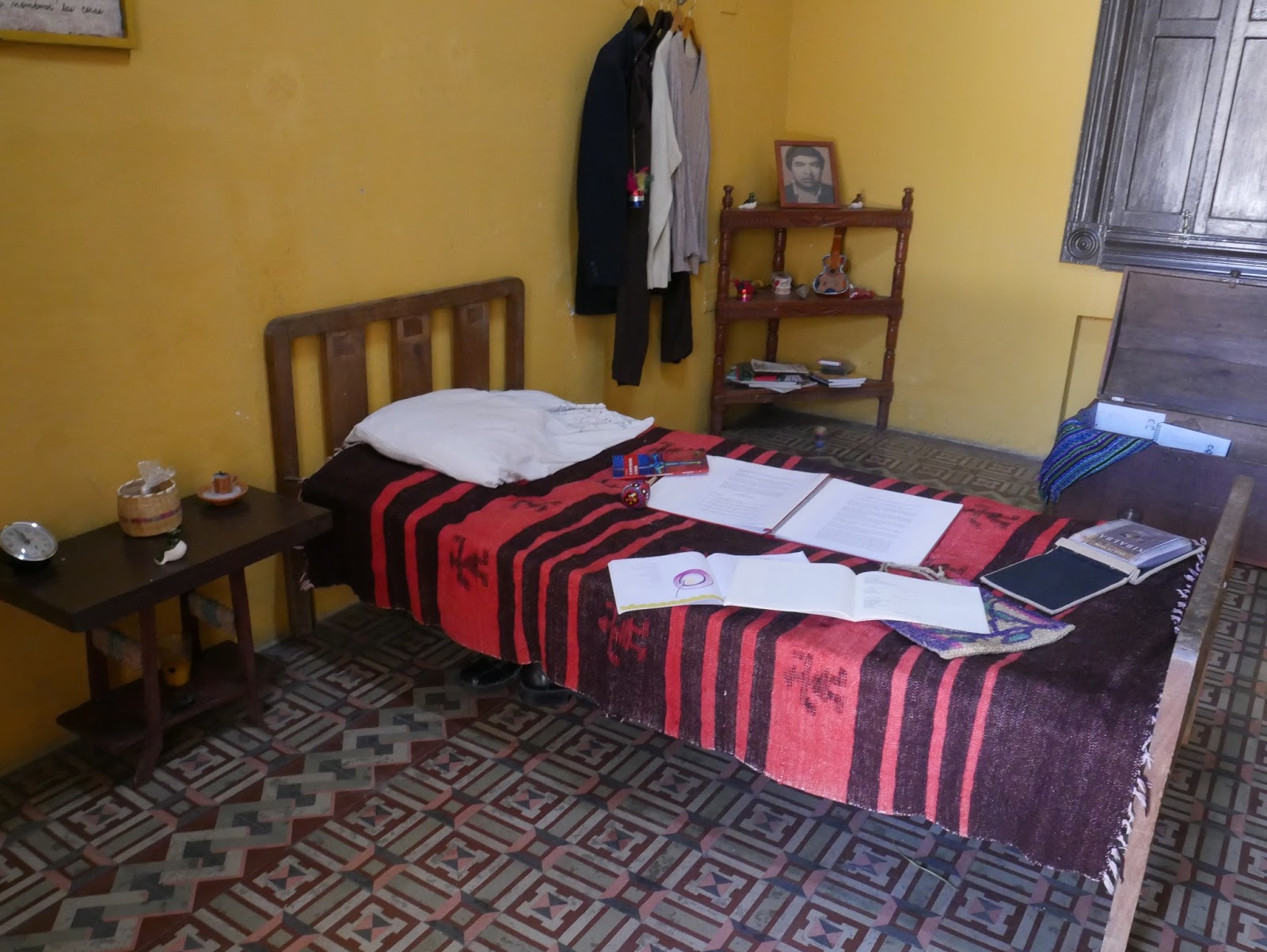
The room contained objects and furniture that had been provided by Luis de Lion's family -- some of which were his, and others were donations that were meant to be representative. A manual typewriter; books; clothing; a modest bedstead covered with a woven blanket. Clothes hung on a hook. A graduation certificate. Fragments of a life that evoke, as the title of the exhibit indicates, both presences and absences.
 On the desk, photocopies of pages from the Diario Militar that confirmed the military's role in Luis de Lion's forced disappearance. A life interrupted. A poet who would never publish another verse. A teacher whose students were robbed. A brother, son, cousin.
There are over 40,000 cases of forced disappearance. This was the tactic used by the military in cities like the capital. In rural villages, the scorched earth campaign articulated in Plan Sofia and other places involved large-scale massacres and in many cases eliminating the entire village from the map (burning all the houses and crops, forcing any survivors into resettlement villages). This obviously couldn't work in the cities, and so the tactic was to pick off individuals -- such as leaders of student organizations or unions, or those who had spoken out publicly. Very few of them have been adjudicated in the courts.
Not everyone who was disappeared was a poet or a leader, but who knows what would have become of those 40,000 if they had not been disappeared and killed? What kinds of engineers, agronomists, artists, laborers, teachers, leaders, cooks, union organizers, did Guatemala lose?
The challenge for small museums like this is lack of support --as the experience of the Amancio Samuel Villatoro Foundation Museum demonstrates. I made a donation to the Cuarto de las Ausencias, but obviously one donation doesn't provide a budget. But if you're in Guatemala City, it's worth arranging a visit. I'll be happy to provide contact information (I'm a little hesitant about publishing it here, and there is no webpage for the Cuarto de las Ausencias).
The museum was devoted to one man whose family had donated artifacts that they had kept -- clothing, books -- and I wanted to see it again. It was located in a small set of rooms just off the entrance of the headquarters of the Forensic Anthropology Foundation (known as FAFG). FAFG are the people who have been documenting and exhuming the sites of mass graves and executions from the armed conflict. It is worth remembering that in Guatemala, being an anthropologist is often a hazardous occupation, especially if one's work relates to the armed conflict. Just ask the family of Myrna Mack Chang, assassinated by a military death squad in 1990 for her human rights advocacy. The staff of FAFG regularly receive death threats and there are armed guards at their headquarters (just for a reality check, there are armed guards at Café Barista, a chain of coffee shops).
I asked a friend in Guatemala if she knew how to get in touch with the people running the museum. My recollection was that it was an all-volunteer operation. She couldn't recall the names but put me in touch with someone at FAFG. However, I decided to search through my emails, and it turns out one of the benefits of having tens of thousands of saved messages is that occasionally I can find important information by trolling through my email. I couldn't remember the name of the museum or the name of the person who was staffing the museum and had given me a tour, but I eventually found an email exchange that included his phone number. I called Don Salomon but, like many Guatemalans, he was no longer using the same phone number that he had given me in 2014, and so after apologizing to the person who answered that number, I sent an email. I wasn't very hopeful because although it seems over half the country has smart phones now, but Don Salomon answered very quickly, gave me his new number, but sadly told me that the Museum had closed because of lack of resources. It was privately funded through contributions and was run primarily by volunteer labor -- principally the family members of people who had appeared in the Diario Militar, like Don Salomon himself. Both of his brothers were disappeared by the military, at different times during the conflict.
 However, he told me, there was another small museum that was in Zona 1, called "El Cuarto de las Ausencias" (the room of absences), and he would be happy to meet me there. Some time back, the folks from Prensa Comunitaria had arranged an exhibit at the Museo de Ferrocarril (the Railway Museum) based on the case of one of the victims of a forced disappearance, Marco Antonio Molina Thiessen. This sounded like it was something similar, but I was eager to see it. So, we arranged a time and he gave me the address, and at the appointed hour I made my way there. It's just one room, in a building that was purchased by a Christian-sponsored network of radio schools and community-oriented radio stations, FGER, to be used as a "centro capacitación" -- a training center, where different groups can hold classes and workshops.

 The one-room museum, Don Salomon told me, was devoted to Luis de Lión, a Guatemalan poet and teacher who was disappeared by the military in the 1980s, but also to the memory of Daniel Pedro Mateo, a Q'anjob'al leader who was a friend of mine, and assassinated in 2013 for his opposition to the hydroelectric and other extractivist projects.
The room contained objects and furniture that had been provided by Luis de Lion's family -- some of which were his, and others were donations that were meant to be representative. A manual typewriter; books; clothing; a modest bedstead covered with a woven blanket. Clothes hung on a hook. A graduation certificate. Fragments of a life that evoke, as the title of the exhibit indicates, both presences and absences.
There are over 40,000 cases of forced disappearance. This was the tactic used by the military in cities like the capital. In rural villages, the scorched earth campaign articulated in Plan Sofia and other places involved large-scale massacres and in many cases eliminating the entire village from the map (burning all the houses and crops, forcing any survivors into resettlement villages). This obviously couldn't work in the cities, and so the tactic was to pick off individuals -- such as leaders of student organizations or unions, or those who had spoken out publicly. Very few of them have been adjudicated in the courts.
Not everyone who was disappeared was a poet or a leader, but who knows what would have become of those 40,000 if they had not been disappeared and killed? What kinds of engineers, agronomists, artists, laborers, teachers, leaders, cooks, union organizers, did Guatemala lose?
The challenge for small museums like this is lack of support --as the experience of the Amancio Samuel Villatoro Foundation Museum demonstrates. I made a donation to the Cuarto de las Ausencias, but obviously one donation doesn't provide a budget. But if you're in Guatemala City, it's worth arranging a visit. I'll be happy to provide contact information (I'm a little hesitant about publishing it here, and there is no webpage for the Cuarto de las Ausencias).
Tuesday, July 25, 2017
Hace un año/One year ago
On July 24, 2016, after nearly two years of being unjustly imprisoned, Rigoberto Juárez and Domingo Baltazár were freed from the "preventive detention" center. They had been held captive by the state since March 2015. I had gone to visit them that morning as it was a Saturday and that was the only day visitors (other than attorneys and special dignitaries) were allowed. We'd gotten the news the night before that they would be released but it wasn't clear exactly when, so I made the trip out to see them, as I usually did when I was in Guatemala during the months of their captivity. Then that night we heard that they were to be released -- I was literally in a car with their wives and some human rights workers, en route to the prison, when we heard that they'd already arrived. It was a gleeful night, and I've written about it earlier.
I never got to write about the caravan that was organized for their return -- theirs, and the other leaders from Barillas who had also been imprisoned. It took some days for the details to be worked out, and so last summer I cooled my heels in the capital until the caravan was ready to go. The caravan was exhilarating and exhausting -- we made stops in Chimaltenango, in Los Encuentros (where the highway splits off for Quiché, and the Panamericana continues on towards the Mexican border). We then stopped again in Sololá, at the Cumbre de Alaska, the spot where leaders from the 48 cantones of Totonicapán were killed by army bullets in 2012, and then at one other location along the highway leading towards Huehuetenango (I don't remember the name of the town offhand), and finally ending up in the Parque Central of Huehuetenango in the afternoon. At each site there was a formal welcome, a rally or speech-making of some sort, sometimes music, food at a few places. I could look at the photographs and try to recount the journey, and maybe at another time I will. We spent the night in Huehuetenango -- I was traveling with several of the young people who were handling the logistics, and we were all crowded into a few rooms at a hotel, and then took off very early in the morning since we were supposed to be in San Juan Ixcoy -- the first stop in Q'anjob'al territory -- for breakfast. In between San Juan and San Pedro Soloma, the next town along the way, a microbus coming the other way was waiting for us on the highway near Kab'tzin, the huge rock formation along the side of the highway that are a local landmark. It was a delegation from Santa Eulalia, including Domingo's daughter Maria (a daughter from his first marriage), who was eager to see her father. Everyone spilled out of the cars and pickups and microbuses and embraced and took photos, and then we resumed our journey to Soloma, where there was a rally in the center of town that blocked traffic all around, and then finally to Santa Eulalia. Before entering the town proper the elders of the Casa de los Abuelos (the spiritual leaders of the community) met us and conducted a brief ceremony at a roadside shrine. Rigoberto was part of the group of elders, and so it was fitting that they would do so.
Once we entered the town, the caravan was met by a brigade of motorcycles, bands, balloons. People got out the vehicles and started to walk, as it was nearly impossible for the vehicles to progress. We finally ended up at the town square, in an emotional rally.
Now, a year later, there is about to be a documentary film released about the situation in northern Huehuetenango. I was getting ready to head to Santa Eulalia and would have left this afternoon (July 25) but saw news of this film screening yesterday, with an announcement that some of the protagonists would be there. I checked with one of my friends in Santa Eulalia today, who confirmed that Rigoberto and several of the leaders from Barillas were going to be coming to the city for the screening, so I stayed, since I'd like to see the film but also to hear how these men (and maybe some of their families) are viewing the situation a year later.
While they are no longer in jail or facing charges, the repression has not stopped. Another leader from Alta Verapaz was arrested a few months ago, and the story seems to be repeating itself.
Death at the border
Next to headlines about a dead body being found somewhere, and another government official sentenced for money laundering, today's Prensa Libre (one of the leading daily newspapers in Guatemala) had an article titled "Three Dead Guatemalans Drowned in the Rio Bravo" (the Rio Bravo is the river that we in the U.S. call the Rio Grande, but Latin Americans calls the Rio Bravo). The story goes on to say that the bodies of two women, ages 15 and 37 and one young man, age 16, were pulled from the river which they were trying to cross in order to get into the U.S. Apparently a young Guatemalan woman who was part of the same group that was trying to cross to the U.S. told authorities that some people had gotten carried away by the currents.
These are everyday tragedies that rarely get reported in the U.S. Hundreds if not thousands die each year trying to enter the country -- either drowned or, probably more often, dying in the desert. Or, like the tragedy last week, suffocating in the back of an airless trailer, abandoned by the coyotes.
The names weren't given in the story about the three bodies pulled from the river; perhaps they are waiting to inform the families. All three were from the western highlands, according to the article.
Monday, July 24, 2017
Memoria histórica/historical memory
The last decade or so has seen a huge battle over the history and memory of the armed conflict. Well, maybe the battle has gone on since the conflict ended nearly 20 years ago. But undoubtedly it has heated up with the genocide trial, and the other high profile cases such as Sepur Zarco (sexual slavery of Q'eqchi women) and Cremopaz -- a military encampment in Alta Verapaz. How is that history to be remember and represented throughout Guatemala is an open question, and this is the subject of a new mini-project I am starting now.
It's been simmering in the back of my mind for some time. During my first trip, or maybe my second, to Guatemala, a friend asked me to find a plaque that had been installed in the town square of San Andrés Sajcabajá in Quiché, his hometown, that had been placed to commemorate the victims of a massacre there, and to photograph his father's name - his father was a community leader killed in the massacre, which was what had prompted my friend to flee Guatemala as a young boy and seek refuge in the U.S. I found the plaque and photographed it. Later, still on one of my early trips, a nun in Zacualpa showed me a chapel in the parish house at the church. The chapel had been used as a torture chamber and there were brass handles (like drawer pulls) on the ceiling beams that had been used to suspend people by their arms while they were tortured. After the war ended, the church had made a decision to keep the room as a reminder. The handles were left on the wooden beams, and parishoners had made small crosses bearing the names of their loved ones who had been killed or disappeared, hanging from the ceiling. A few years later, on another trip to Zacualpa - this might have been in 2011 -- there was a large monument in the outdoor courtyard of the parish, a space where people frequently came to rest and escape the sun on market days (as the church is right on the main market square).
On another occasion, prior to 2011, I visited the family of a friend whose mother had been burned alive, along with her two young siblings. There was no formal marker or plaque but we went to the spot in the cornfields where their house had been, which the sister said was the site, and lit a candle and left some flowers.
About a year ago, just walking along La Sexta (Sixth Avenue), one of the main thoroughfares of Zona 1, the historic district, which is where I usually stay, I noticed a small museum on the eastern side of the street. Kaji Tulam, Casa de la Memory -- house of memory. I went in, viewed the exhibit, and didn't think much more about it.
There are other forms of historical marking -- graffiti on the walls, the 8-1/2x11 photocopied leaflets that the group H.I.J.O.S. posts around Zona 1 -- each bearing a photograph of a person who was disappeared, with the date of disappearance or date of death (if know) and the name, under the slogan "Donde están?" (Where are they?). After the disappearances of the 43 Mexican students in Ayotzinapa, there was a lot of graffiti about the 43. About two years ago, during the anti-government protests, I noticed that someone had made a series of stencils all around the Zona 1. The pattern at the center was the same, but each one bore the name of one of the students, and a number: 18/43 (18 out of 43), 16/43 (16 out of 43). I photographed the ones I saw but I don't think I photographed all 43.
History is written on the walls -- and not only in heavily populated areas like the capital. But I started to get interested in how the history of the armed conflict was represented and marked in more permanent ways in public space.
So, as I was planning this trip, I decided that I wanted to start looking at memory sites in Guatemala. I've spent part of the last two days doing this in the capital.. and will be posting some of my photos and thoughts.
Subscribe to:
Posts (Atom)